Pick a lab, press Play and watch what happens. Change one thing at a time, guess what will happen next, then check. Every lab matches a chapter in your NCERT book. Each lab has 20 practice questions (easy, medium and hard): the first 5 are free, the rest come with SimuVeda Pro.
PlayOpen a lab and press Play to see it move.
PredictChange one slider. Guess what happens, then watch.
PractiseAnswer the questions under the lab to check you understood.
17 labs for Class 6–8. Sign in to keep your score and see your progress here.
Physics
Intermediate
Geometric Optics
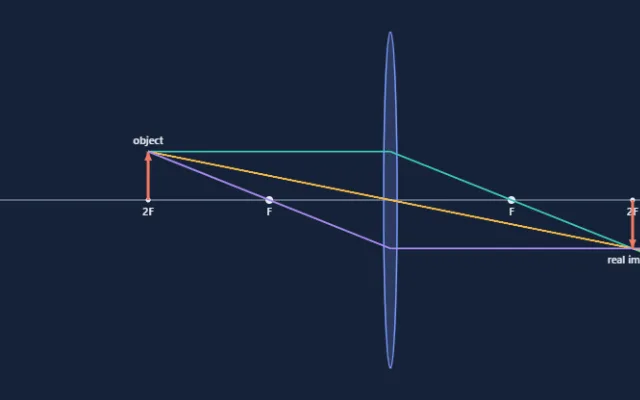
Move a candle in front of a lens and see where its picture appears, big or small, upright or upside down.
Physics · Optics
Class 6–8 · Class 9–10 · Class 11–12Class 7 Science: light (images formed by lenses)
Try at home · Words to know
Try at home: Hold a magnifying glass between a window and a white wall or paper. Move it until you see a sharp, upside-down picture of the window. A lens can form an image on a screen.
Lens
A curved piece of glass or plastic that bends light.
Image
The picture of an object formed by a lens or mirror.
Focus
The point where light rays meet after passing through a lens.
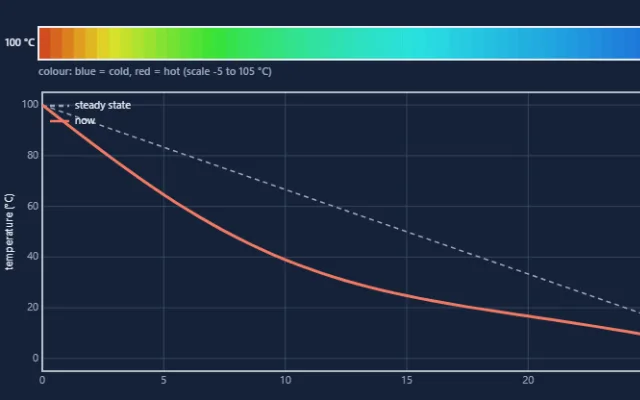
Heat one end of a metal rod and watch the warmth creep along it.
Physics · Heat & Gases
Class 6–8 · Class 11–12Class 7 Science: heat and conduction
Try at home · Words to know
Try at home: Put a steel spoon and a plastic or wooden spoon in the same cup of hot tea or water (ask an adult). After a minute, gently touch the handles. Which one carried the heat up to your hand?
Conduction
Heat moving through a solid from the hot part to the cold part.
Conductor
A material that lets heat pass easily, like metal.
Insulator
A material that slows heat down, like wood or plastic.
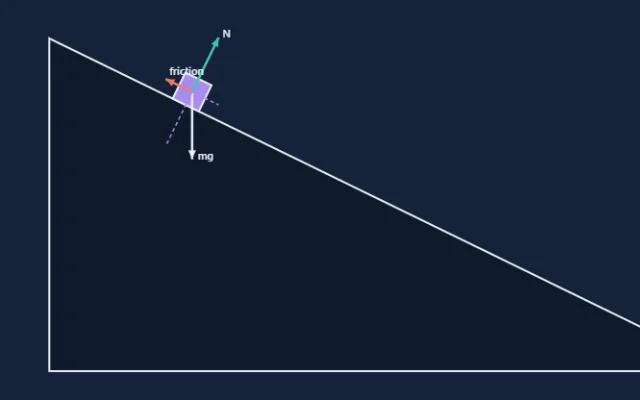
Put a box on a slope and make the slope steeper. When does it start to slide?
Physics · Mechanics
Class 6–8 · Class 11–12Class 8 Science: friction and force
Try at home · Words to know
Try at home: Rest a book on a tray and slowly lift one end. Note how steep it is when the book starts to slide. Try again with a sheet of paper or a cloth under the book. Which surface needs the steeper slope?
Friction
A force that resists one surface sliding over another.
Send electricity through a wire or a coil and see the invisible magnetic field around it.
Physics · Electricity & Magnetism
Class 6–8 · Class 9–10 · Class 11–12Class 7 Science: electric current and its effects (electromagnets)
Try at home · Words to know
Try at home: Sprinkle a few pins or paper clips near a magnet and see which way they point. With an adult, wind wire around an iron nail and touch the ends to a cell for a moment: the nail becomes a magnet.
Magnet
An object that attracts iron and has north and south poles.
Magnetic field
The space around a magnet where its force acts.
Electromagnet
A magnet made by passing current through a coil of wire.
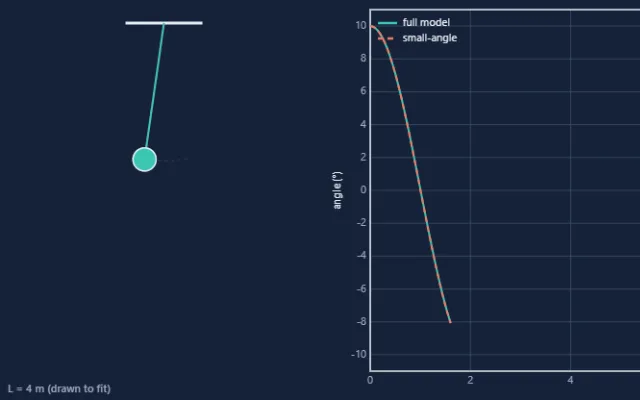
Make a swing go faster or slower by changing its string. Time the swings and find the pattern.
Physics · Mechanics, Waves & Sound
Class 6–8 · Class 11–12Class 7 Science: measurement of time and motion
Try at home · Words to know
Try at home: Tie a key or a small bag to a string about 50 cm long and let it swing gently. Count 10 swings with a clock and divide by 10. Now halve the string and time it again. Shorter string, faster swing?
Pendulum
A weight on a string or rod that swings to and fro.
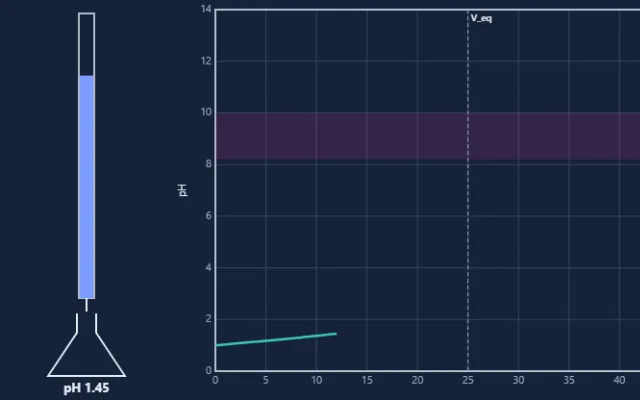
Add a base to an acid drop by drop and watch the indicator colour flip when they cancel out.
Chemistry · Acids & Bases
Class 6–8 · Class 9–10 · Class 11–12Class 7 Science: acids, bases and salts (indicators and neutralisation)
Try at home · Words to know
Try at home: With an adult, boil a few red cabbage leaves in water and let it cool: the purple water is an indicator. Add a few drops to lemon juice, then to soap water. Acids and bases turn it different colours.
Acid
A sour substance, like lemon juice or vinegar.
Base
A bitter, soapy substance, like baking soda in water.
Indicator
A substance that changes colour in an acid or a base.
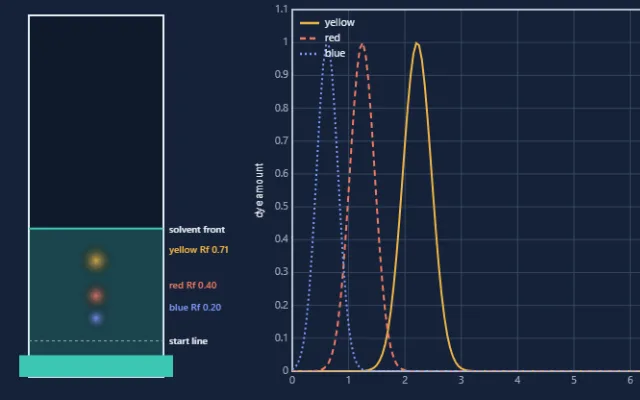
Put an ink dot on paper, let water run up, and watch the hidden colours separate.
Chemistry · Separation
Class 6–8 · Class 9–10 · Class 11–12Class 6 Science: separating substances
Try at home · Words to know
Try at home: Draw a thick dot with a black washable marker 2 cm from the bottom of a strip of kitchen paper. Dip the very bottom in a little water, keeping the dot above the water. Watch the ink split into colours.
Mixture
Two or more substances mixed together.
Chromatography
A way to separate the colours or parts of a mixture.
Solvent
The liquid that carries the substances, here water.
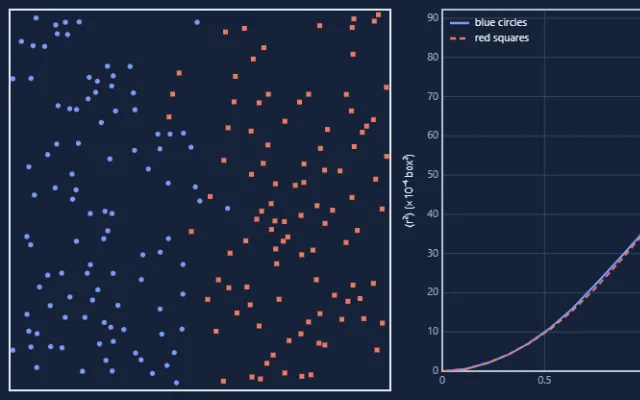
Two gases start apart. Watch tiny particles wander until they are fully mixed.
Chemistry · Thermochemistry & Mixtures
Class 6–8 · Class 9–10Class 9 Science: Matter in Our Surroundings (diffusion)
Try at home · Words to know
Try at home: Drop one drop of food colour into a glass of cold water and another into warm water (ask an adult). Do not stir. Watch which glass mixes faster.
Diffusion
Particles spreading out and mixing on their own.
Particle
A tiny piece of matter, too small to see.
Temperature
How hot or cold something is; hotter particles move faster.
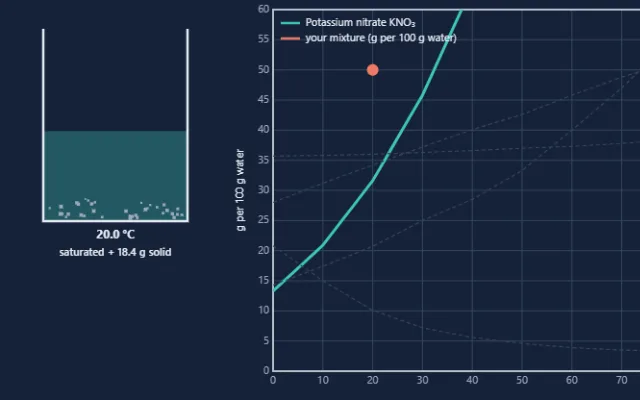
Stir salt into water until no more dissolves. Warm it up and see what changes.
Chemistry · Thermochemistry & Mixtures
Class 6–8 · Class 9–10 · Class 11–12Class 6 Science: separation of substances (saturated solutions)
Try at home · Words to know
Try at home: Stir salt into a glass of water one spoon at a time. Count the spoons until salt stays at the bottom. That water is now saturated. Ask an adult to warm it a little: can it take one more spoon?
Dissolve
When a solid mixes into a liquid and seems to disappear.
Solution
A liquid with something dissolved in it.
Saturated
A solution that cannot dissolve any more at that temperature.
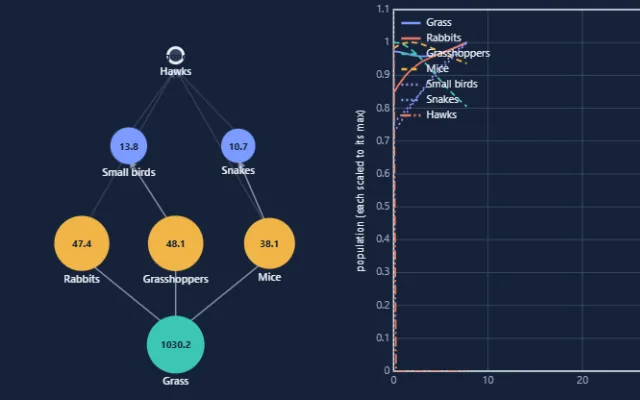
Change how many rabbits, birds or snakes there are and see who goes hungry.
Biology · Ecology
Class 6–8 · Class 9–10 · Class 11–12Class 10 Science: Our Environment (food chains and webs); Class 12 Biology: Ecosystem
Try at home · Words to know
Try at home: Pick an animal you saw today, like a crow or a lizard. Draw what it eats and what eats it, and keep going down to a plant. Join the arrows: you have made a food chain.
Producer
A living thing that makes its own food, like a plant.
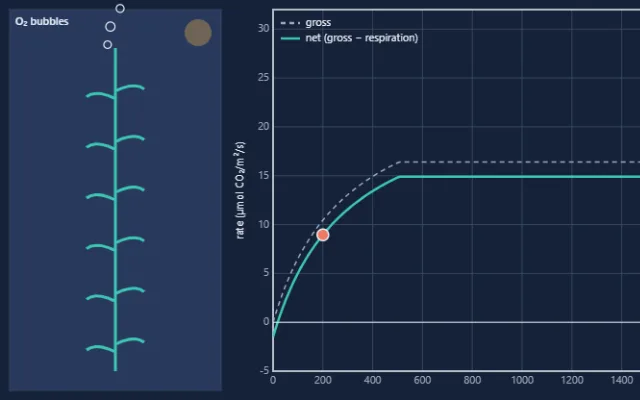
Give a leaf more light, more air or more warmth and see how fast it makes food.
Biology · Cells & Physiology
Class 6–8 · Class 9–10 · Class 11–12Class 7 Science: nutrition in plants
Try at home · Words to know
Try at home: Cover part of a leaf on a potted plant with a strip of black paper for a few days. Then remove it. The covered part looks paler because it got no light to make food.
Photosynthesis
How green plants make food from sunlight, water and carbon dioxide.
Chlorophyll
The green colour in leaves that captures sunlight.
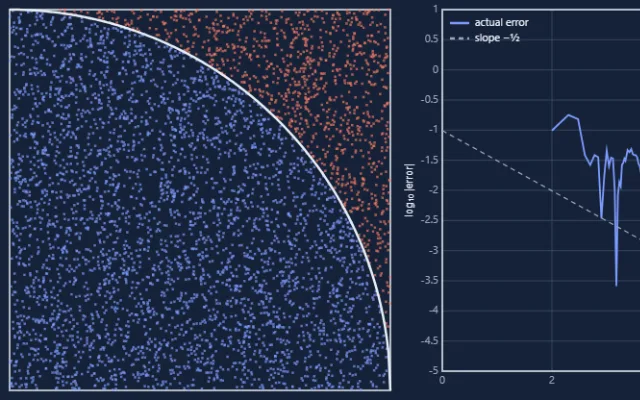
Throw lots of random dots and use them to guess an area. More dots, better guess.
Mathematics · Probability & Statistics
Class 6–8 · Class 9–10 · Class 11–12Class 8 Maths: data handling (chance and probability)
Try at home · Words to know
Try at home: Toss a coin 10 times and count heads. Then toss it 50 times. With more tosses, the share of heads gets closer to one half. That is chance at work.
Chance
How likely something is to happen.
Probability
Chance written as a number from 0 (never) to 1 (always).
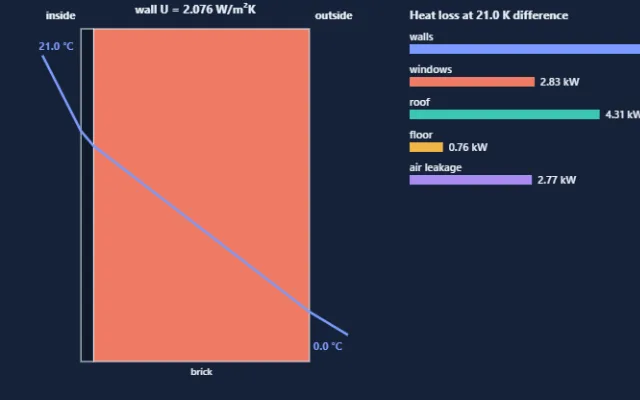
Wrap a house in warm layers and see how much heat stays inside.
Engineering · Energy Systems
Class 6–8 · Class 11–12 · College & beyondClass 7 Science: heat (conductors and insulators)
Try at home · Words to know
Try at home: Wrap one cup of warm water in a towel and leave another cup bare (ask an adult for the water). Check both after 20 minutes. The wrapped cup stays warmer because the towel is an insulator.
Insulation
Material that slows down the loss of heat.
Heat loss
Heat escaping from a warm place to a colder one.
Window glazing
The glass in a window; two layers keep heat in better.
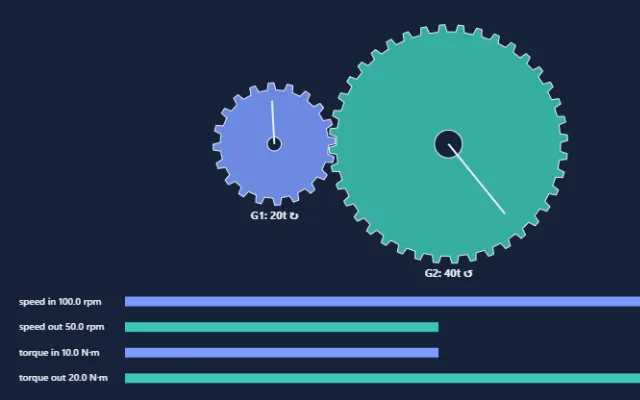
Join big and small gears and see which way they turn and how fast.
Engineering · Structures & Mechanisms
Class 6–8 · College & beyondBuilds on Class 6–8 Maths: ratio and proportion
Try at home · Words to know
Try at home: Look at a bicycle. Count the teeth on the front gear and the back gear. Turn the pedal once slowly and count how many times the back wheel turns.
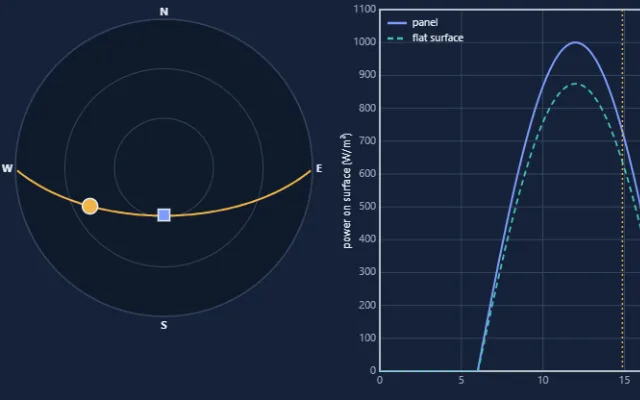
Follow the sun across the sky and tilt a solar panel to catch the most light.
Engineering · Energy Systems
Class 6–8 · Class 11–12Class 6 Social Science: Earth's motions and seasons
Try at home · Words to know
Try at home: Stand a pencil upright in clay in a sunny spot. Mark the tip of its shadow every hour. The shadow moves and changes length as the sun crosses the sky.
Shadow
A dark shape where an object blocks light.
Sunrise and sunset
When the sun appears and disappears as the Earth turns.
Tilt
How much something leans; solar panels are tilted towards the sun.
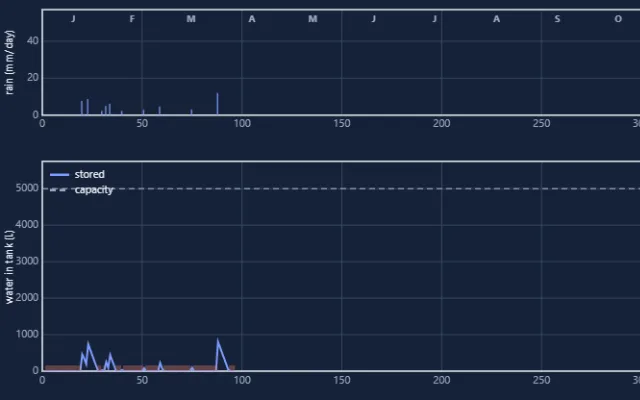
Catch rain from a roof in a tank and see if it lasts through the dry months.
Earth & Environment · Water & Hydrology
Class 6–8 · Class 9–10Class 10 Geography: Water Resources (rainwater harvesting)
Try at home · Words to know
Try at home: Place a wide bowl outside the next time it rains and measure the water depth with a ruler. Multiply by your roof area to guess how much rain your roof collects.
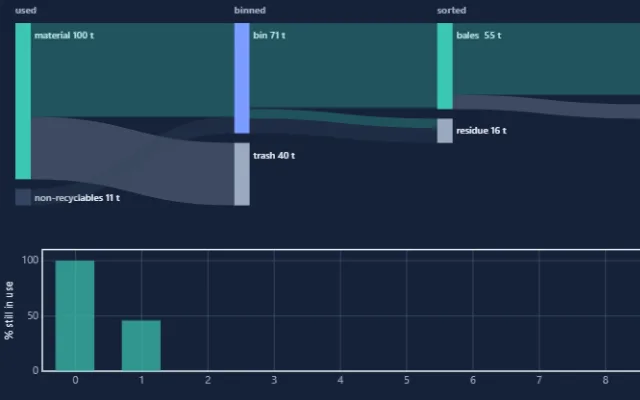
Follow a pile of old packets and bottles and see how much becomes something new.
Earth & Environment · Resources & Waste
Class 6–8 · Class 9–10Class 10 Science: Our Environment (managing waste)
Try at home · Words to know
Try at home: For one day, sort your home's waste into paper, plastic, metal and food. Which pile is biggest? Which items could be reused or recycled instead of thrown away?
Recycle
To turn used material into something new.
Reuse
To use something again instead of throwing it away.