Place current-carrying wires going into and out of the page, and visualise the magnetic field lines, strength and direction they create, including coils and parallel-wire forces.
Physics · Electricity & Magnetism
Class 9–10 · Class 11–12Class 10 Science: Magnetic Effects of Electric Current; Class 12 Physics: Moving Charges and Magnetism
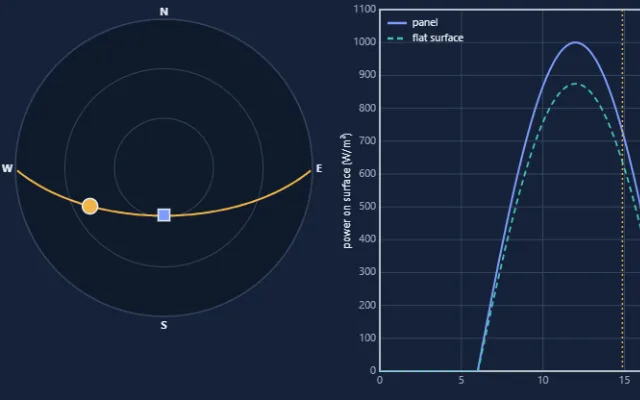
Change latitude, date, time of day, panel tilt and orientation, and see the sun's path across the sky, the angle at which sunlight strikes the panel, and idealized daily energy.
Engineering · Energy Systems
Class 6–8 · Class 11–12Class 6 Social Science: Earth's motions and seasons; Class 11 Geography: Solar Radiation, Heat Balance and Temperature
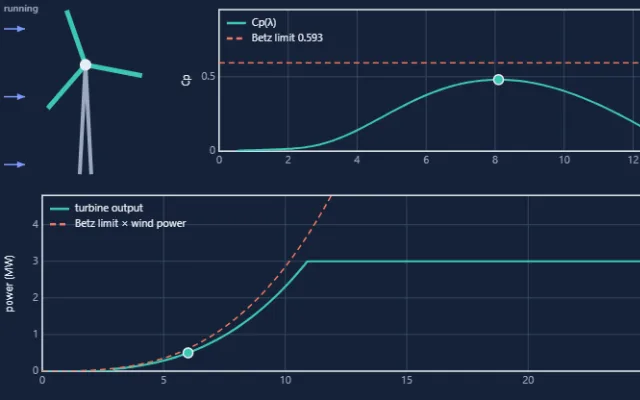
Change wind speed, rotor size, air density and rotor control, and inspect a bounded power model with the cube law, the Betz limit, tip-speed ratio and a rated-power cap.
Engineering · Energy Systems
Class 9–10 · College & beyondBuilds on Class 9 Science: Work and Energy (kinetic energy)
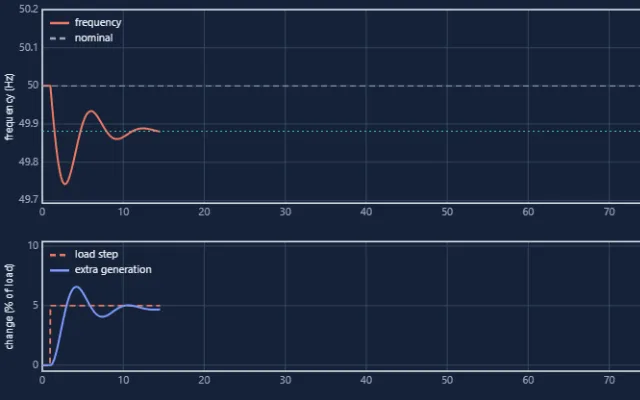
Trip a power station or add load, and watch a simplified grid's frequency fall and recover through inertia, governor droop and automatic generation control.
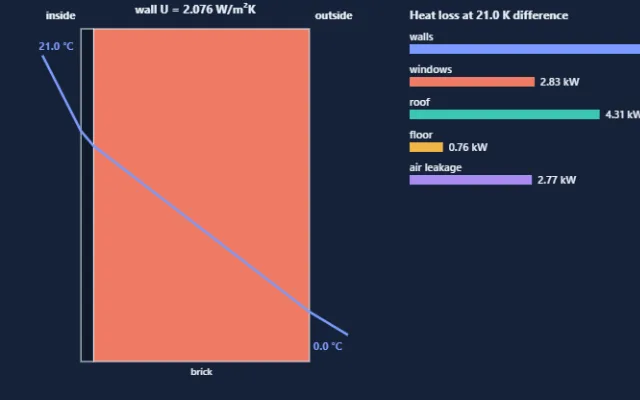
Choose wall and roof insulation, glazing and air-tightness for a two-storey house, set the weather, and compare U-values, the temperature profile through the wall, and idealized heat loss.
Engineering · Energy Systems
Class 11–12 · College & beyondClass 11 Physics: Thermal Properties of Matter (conduction)
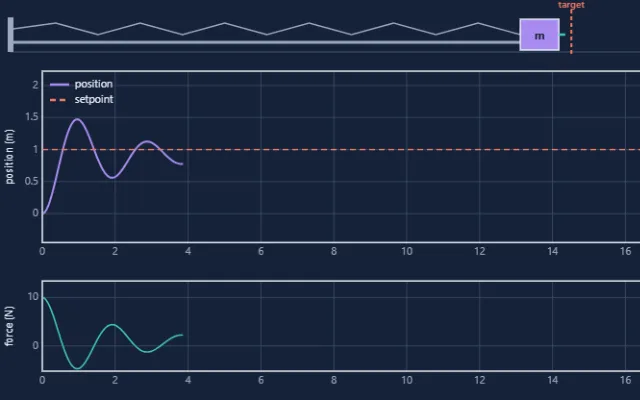
Tune proportional, integral and derivative gains on a mass–spring–damper, add a disturbance and actuator limits, and inspect overshoot, settling time and steady-state error.
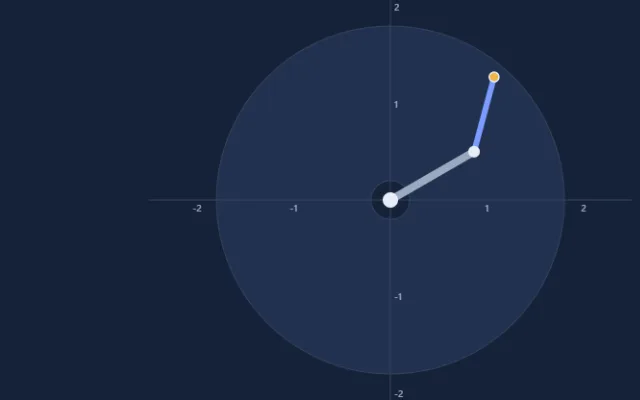
Set joint angles or drag a target for a two-link planar robot arm, and inspect forward and inverse kinematics, elbow-up and elbow-down solutions, reachability, and joint versus straight-line motion.
Engineering · Control Systems
Class 11–12 · College & beyondBuilds on Class 11 Maths: Trigonometric Functions
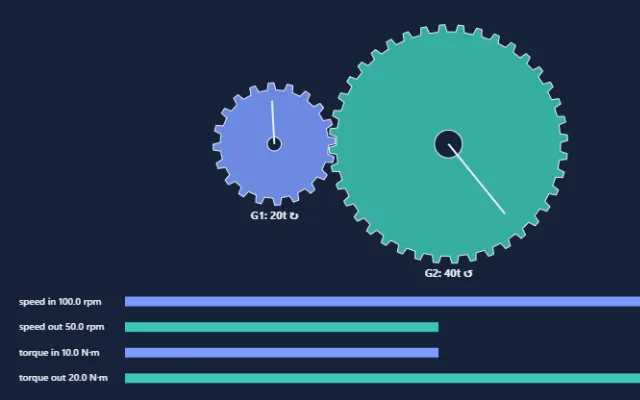
Change tooth counts in simple and compound gear trains, and inspect rotation direction, speed ratio and ideal output torque with animated meshing gears.
Engineering · Structures & Mechanisms
Class 6–8 · College & beyondBuilds on Class 6–8 Maths: ratio and proportion
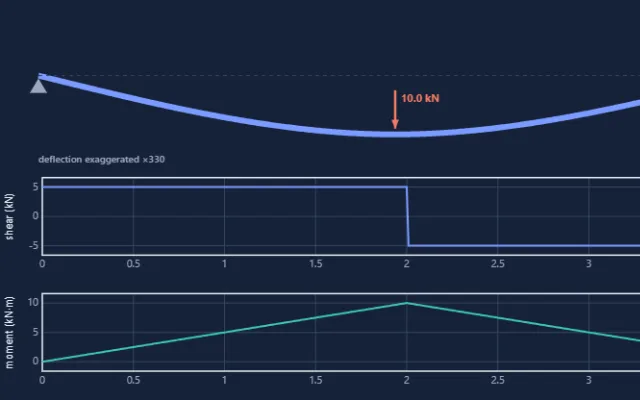
Load a simply supported or cantilever beam with point and distributed loads, change span, material and cross-section, and inspect deflection, bending moment, shear and stress in the small-deflection Euler–Bernoulli model.
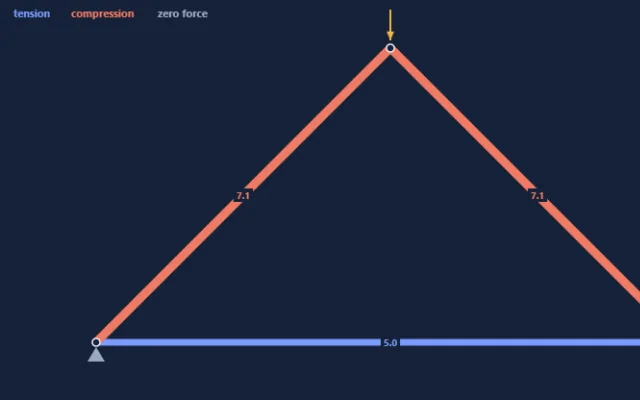
Load stable truss presets (A-frame, Pratt, Howe and Warren), change span, height and loads, and visualize tension and compression in every member found by the method of joints.
Engineering · Structures & Mechanisms
Class 11–12 · College & beyondBuilds on Class 11 Physics: Laws of Motion (equilibrium of forces)
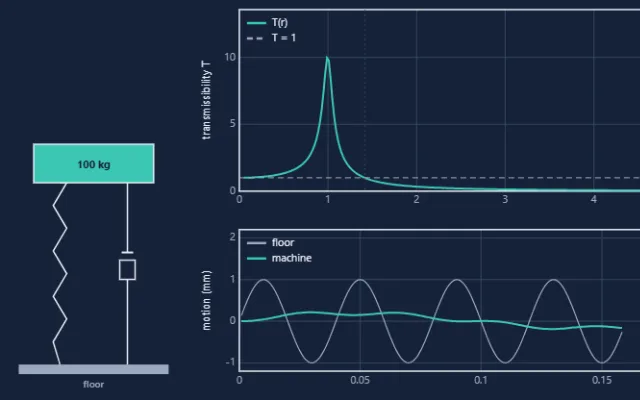
Mount a machine on springs and dampers over a shaking floor, change mass, stiffness, damping and excitation frequency, and compare transmissibility and resonance.
Engineering · Structures & Mechanisms
Class 11–12 · College & beyondClass 11 Physics: Oscillations (forced oscillations, resonance)
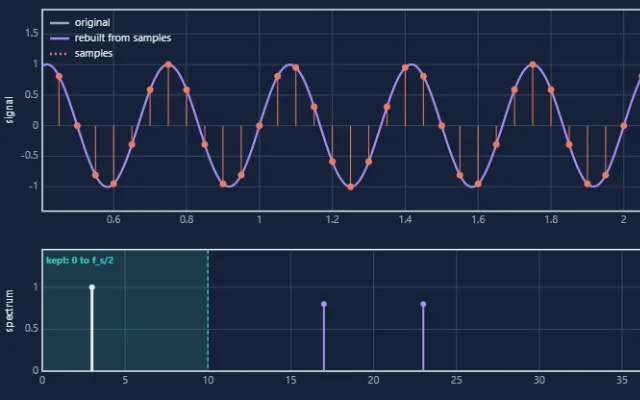
Change a signal's frequency and the sampling rate, observe aliasing, compare sinc and staircase reconstruction, and see how quantization bits limit precision.
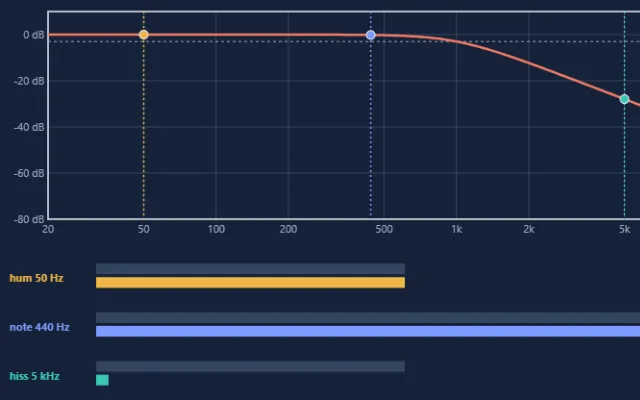
Adjust low-pass, high-pass, band-pass and notch filters, inspect their frequency response on a decibel scale, see what they do to hum, a tone and hiss, and optionally listen to the result.