Live
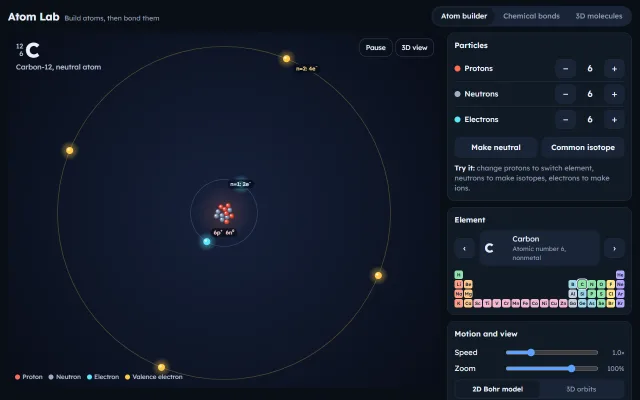
Atom Lab
Build atoms by adding protons, neutrons and electrons, and see how the element, charge and isotope change.
Class 9–10 · Class 11–12Class 9 Science: Structure of the Atom; Class 11 Chemistry: Structure of Atom
Launch simulator: Atom LabRun reactions you can pause and rewind: change temperature and concentration, titrate an acid, build a battery, and separate a mixture.
15 live simulators
Build atoms by adding protons, neutrons and electrons, and see how the element, charge and isotope change.
Class 9–10 · Class 11–12Class 9 Science: Structure of the Atom; Class 11 Chemistry: Structure of Atom
Launch simulator: Atom Lab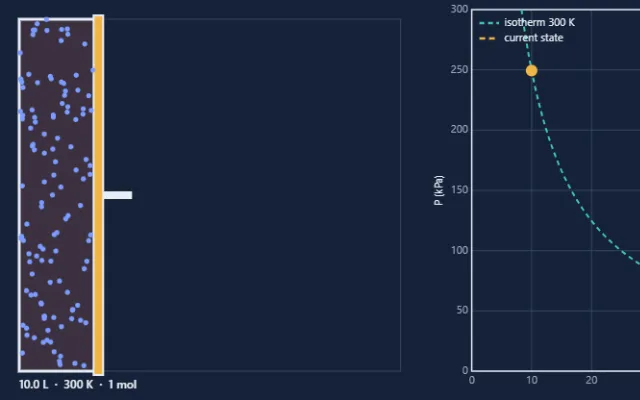
Squeeze, heat and fill a gas-filled piston, hold one quantity constant, and see Boyle's, Charles's and Gay-Lussac's laws emerge from bouncing particles.
Class 11–12Class 11 Physics: Kinetic Theory (gas laws)
Launch simulator: Gas Laws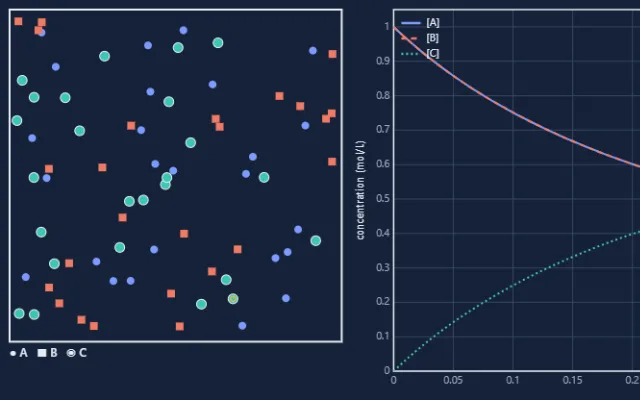
Run a reaction A + B → C, change temperature, concentration and activation energy, and compare particle collisions with the rate law and Arrhenius equation.
Class 11–12Class 12 Chemistry: Chemical Kinetics
Launch simulator: Reaction Rates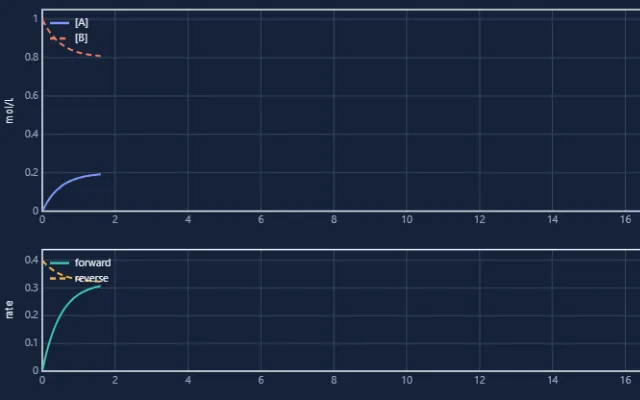
Run a reversible reaction A ⇌ B to equilibrium, then add reactant, remove product or change temperature, and watch Le Chatelier's principle at work.
Class 11–12Class 11 Chemistry: Equilibrium
Launch simulator: Chemical Equilibrium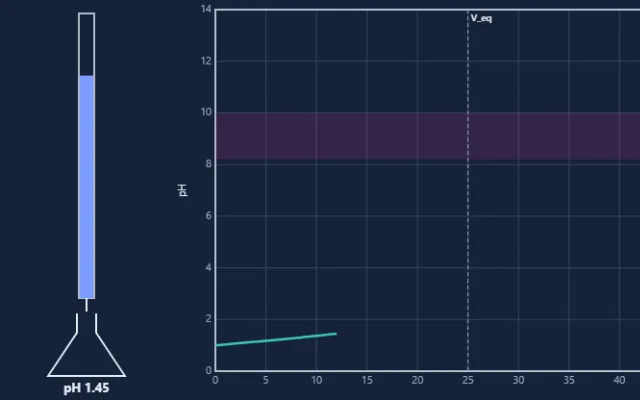
Add base from a burette to an acid, graph the pH curve, and identify the equivalence point, buffer region and a suitable indicator.
Class 9–10 · Class 11–12Class 10 Science: Acids, Bases and Salts; Class 11 Chemistry: Equilibrium (ionic)
Launch simulator: Acid–Base Titration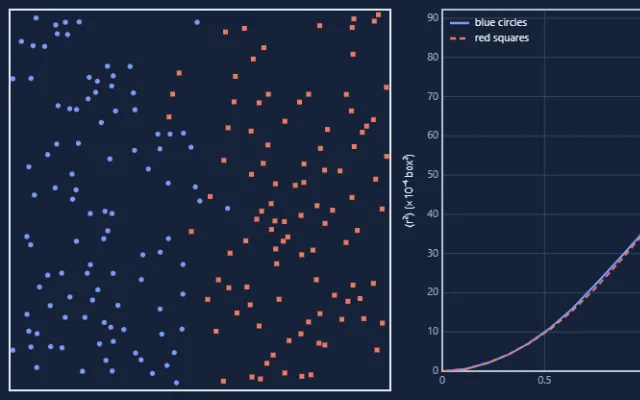
Release two gases on either side of a barrier, change temperature and particle count, and compare mixing with random-walk displacement statistics.
Class 6–8 · Class 9–10Class 9 Science: Matter in Our Surroundings (diffusion)
Launch simulator: Molecular Diffusion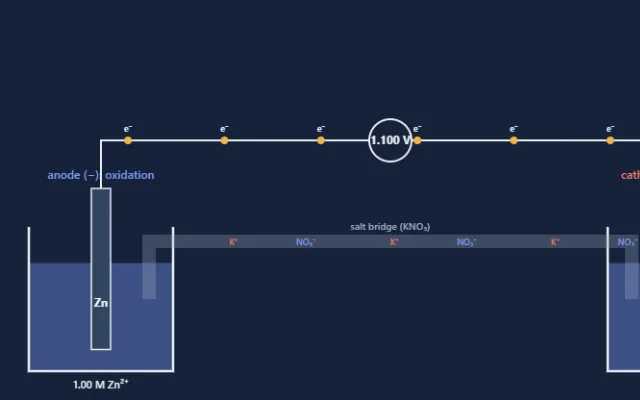
Build a galvanic cell from two half-cells, see which electrode is the anode, follow electron and ion flow, and calculate the cell voltage with the Nernst equation.
Class 11–12Class 12 Chemistry: Electrochemistry
Launch simulator: Electrochemical Cell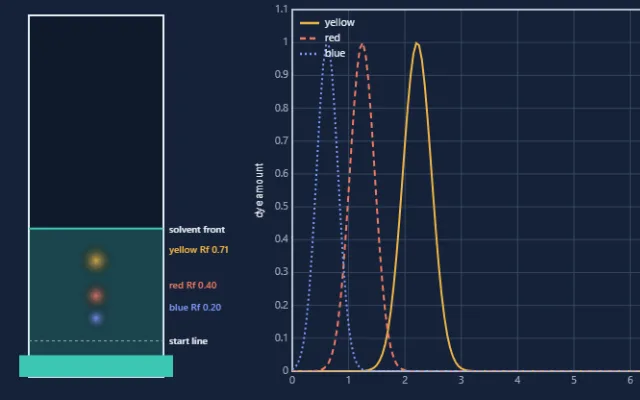
Spot a mixture on a strip, change each dye's affinity and the solvent flow, and watch components separate by retention factor.
Class 6–8 · Class 9–10 · Class 11–12Class 6 Science: separating substances; Class 11 Chemistry: methods of purification
Launch simulator: Chromatography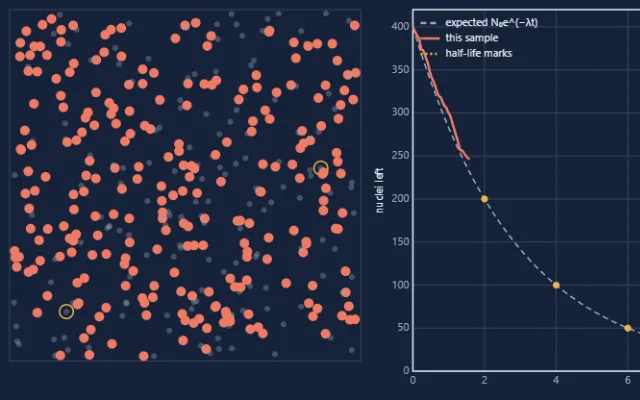
Watch a sample of unstable nuclei decay at random, change half-life and starting count, and compare the stochastic count with the exponential expectation.
Class 11–12 · College & beyondClass 12 Physics: Nuclei
Launch simulator: Radioactive Decay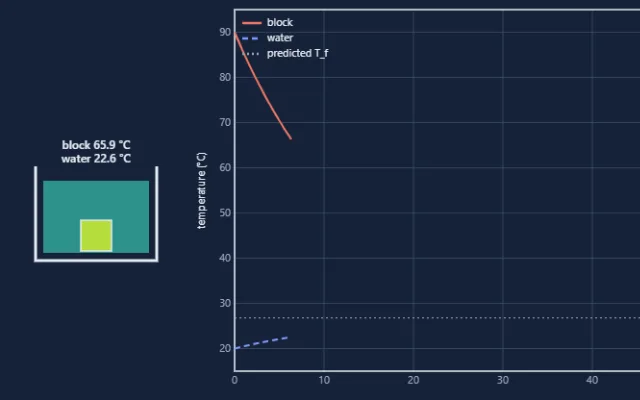
Drop a hot metal into water in an insulated cup, change masses, materials and temperatures, and solve the energy balance for the final temperature.
Class 11–12Class 11 Physics: Thermal Properties of Matter; Class 11 Chemistry: Thermodynamics
Launch simulator: Calorimetry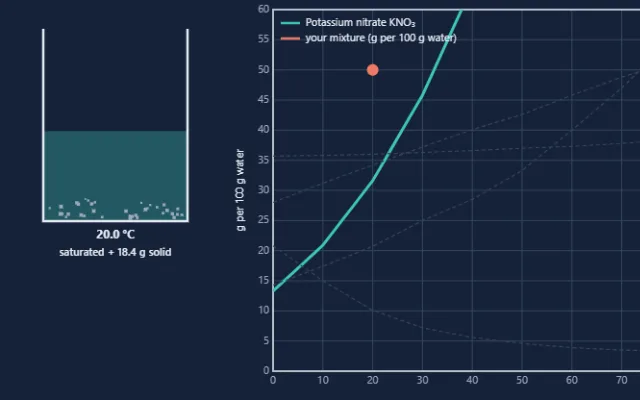
Dissolve salts in water, change temperature and amount, and see when a solution becomes saturated and excess solid remains or crystallises out.
Class 9–10 · Class 11–12Class 9 Science: Is Matter Around Us Pure (solutions); Class 12 Chemistry: Solutions
Launch simulator: Solubility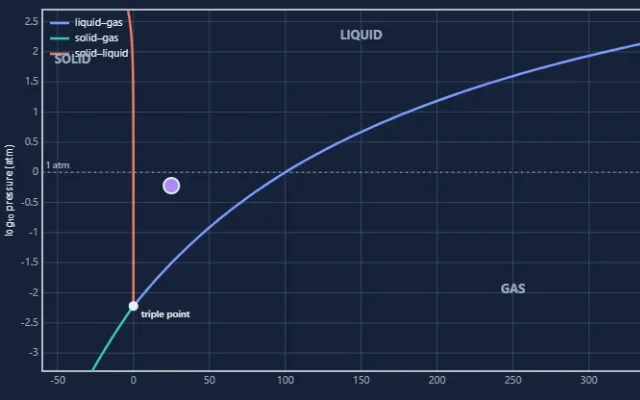
Move a sample of water or carbon dioxide around its pressure–temperature phase diagram and see where it is solid, liquid, gas or supercritical.
Class 11–12 · College & beyondExtends Class 9 states of matter; phase diagrams are college level
Launch simulator: Phase Diagram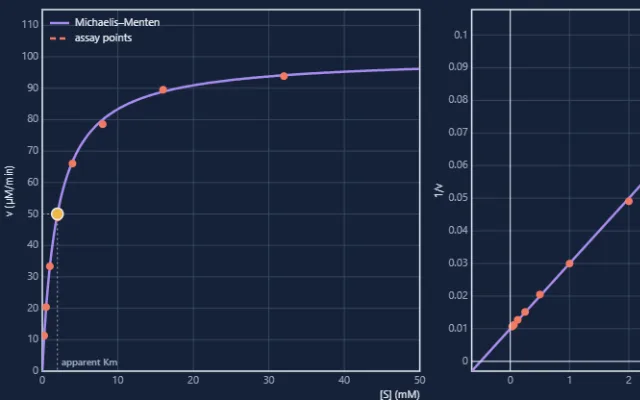
Change substrate concentration, Vmax, Km and inhibitor type, and read reaction velocity curves and Lineweaver–Burk plots.
Class 11–12 · College & beyondClass 11 Biology: Biomolecules (enzymes)
Launch simulator: Enzyme Kinetics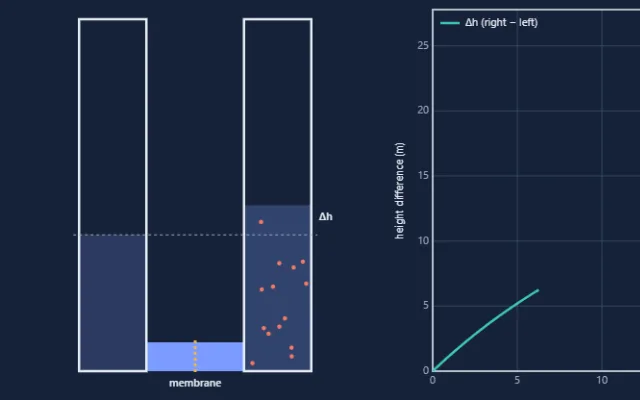
Separate two solutions with a semi-permeable membrane, change concentrations and permeability, and watch net water movement and osmotic pressure.
Class 9–10 · Class 11–12Class 9 Science: The Fundamental Unit of Life (osmosis); Class 12 Chemistry: Solutions (osmotic pressure)
Launch simulator: Osmosis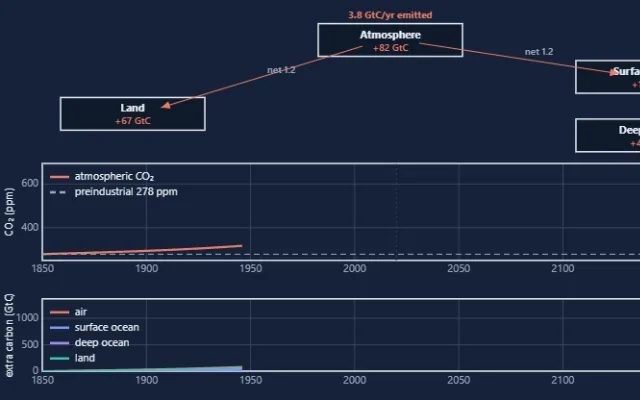
Run a four-reservoir carbon cycle box model from 1850 to 2200, change future emissions and exchange rates, and track atmospheric CO₂ and where the emitted carbon goes.
Class 11–12 · College & beyondClass 11 Geography: World Climate and Climate Change
Launch simulator: Carbon CycleSee the planned labs below, or pick another topic.