Home / All simulators All simulators
104 live simulators across 9 subjects. Search or filter by subject, class, topic or difficulty. Class matches follow CBSE/NCERT topics as a guide; check your current syllabus.
Matching lessons
Open a specific lesson inside a lab.
Sorting race
Six sorts get the same input and each plays one step of its animation per tick. A step is roughly one comparison or one move, so the finishing order shows how much work each one does on this input.
Computer Science · Algorithms, Data Structures
Class 11–12 · College & beyond Lesson in Algo Simulator
Open lesson : Sorting race
Bubble sort
Walk through the array and swap any neighbors that are out of order. After each pass, the largest remaining value has bubbled to the end.
Computer Science · Algorithms, Data Structures
Class 11–12 · College & beyond Lesson in Algo Simulator
Open lesson : Bubble sort
Selection sort
Find the smallest value in the unsorted part and swap it to the front. Repeat until nothing is left.
Computer Science · Algorithms, Data Structures
Class 11–12 · College & beyond Lesson in Algo Simulator
Open lesson : Selection sort
Insertion sort
Keep the left part sorted. Take the next value (the key) and slide it left past every bigger value.
Computer Science · Algorithms, Data Structures
Class 11–12 · College & beyond Lesson in Algo Simulator
Open lesson : Insertion sort
Shell sort
Insertion sort, but first on values that are gap apart. Big gaps move far-away values quickly; the last pass with gap 1 is a normal insertion sort on an almost sorted array.
Computer Science · Algorithms, Data Structures
Class 11–12 · College & beyond Lesson in Algo Simulator
Open lesson : Shell sort
Merge sort
Split the array in half until each piece has one value, then merge the pieces back together in order.
Computer Science · Algorithms, Data Structures
Class 11–12 · College & beyond Lesson in Algo Simulator
Open lesson : Merge sort
Quick sort
Pick a pivot, move smaller values to its left and bigger ones to its right, then sort each side the same way.
Computer Science · Algorithms, Data Structures
Class 11–12 · College & beyond Lesson in Algo Simulator
Open lesson : Quick sort
Heap sort
Turn the array into a max-heap so the biggest value sits at index 0. Swap it to the end, shrink the heap by one, and repair it. Repeat.
Computer Science · Algorithms, Data Structures
Class 11–12 · College & beyond Lesson in Algo Simulator
Open lesson : Heap sort
Counting sort
No comparisons at all. Count how many times each value appears, then write the values back from smallest to largest.
Computer Science · Algorithms, Data Structures
Class 11–12 · College & beyond Lesson in Algo Simulator
Open lesson : Counting sort
Radix sort (LSD)
Sort by the ones digit, then by the tens digit, keeping ties in their previous order. After the last digit the whole array is sorted, without comparing two values.
Computer Science · Algorithms, Data Structures
Class 11–12 · College & beyond Lesson in Algo Simulator
Open lesson : Radix sort (LSD)
Linear search
Check every value from left to right until you find the target or run out of values.
Computer Science · Algorithms, Data Structures
Class 11–12 · College & beyond Lesson in Algo Simulator
Open lesson : Linear search
Jump search
On a sorted array, jump ahead √n values at a time until you pass the target, then walk back through that one block with a linear scan.
Computer Science · Algorithms, Data Structures
Class 11–12 · College & beyond Lesson in Algo Simulator
Open lesson : Jump search
Binary search
On a sorted array, look at the middle value. If it is too small, throw away the left half. If too big, throw away the right half.
Computer Science · Algorithms, Data Structures
Class 11–12 · College & beyond Lesson in Algo Simulator
Open lesson : Binary search
Reverse a linked list
Walk the list once. At each node, save next, point the node back to prev, then move prev and curr one step forward.
Computer Science · Algorithms, Data Structures
Class 11–12 · College & beyond Lesson in Algo Simulator
Open lesson : Reverse a linked list
Floyd's cycle detection
slow moves 1 step, fast moves 2. With a cycle, fast laps slow and they meet. Without one, fast reaches null.
Computer Science · Algorithms, Data Structures
Class 11–12 · College & beyond Lesson in Algo Simulator
Open lesson : Floyd's cycle detection
Remove the Nth node from the end
Move fast n + 1 steps ahead of slow. Then move both until fast falls off the end: slow now sits just before the node to remove.
Computer Science · Algorithms, Data Structures
Class 11–12 · College & beyond Lesson in Algo Simulator
Open lesson : Remove the Nth node from the end
Stack: valid parentheses
Push every opening bracket. A closing bracket must match the top of the stack. At the end, the stack must be empty.
Computer Science · Algorithms, Data Structures
Class 11–12 · College & beyond Lesson in Algo Simulator
Open lesson : Stack: valid parentheses
BST insert
Start at the root. Go left if the new value is smaller, right if bigger, until you reach an empty spot.
Computer Science · Algorithms, Data Structures
Class 11–12 · College & beyond Lesson in Algo Simulator
Open lesson : BST insert
BST search
Each comparison throws away one whole subtree, so a balanced tree is searched in O(log n) steps.
Computer Science · Algorithms, Data Structures
Class 11–12 · College & beyond Lesson in Algo Simulator
Open lesson : BST search
BST delete
Find the node. With zero or one child, its child takes its place. With two children, copy in the smallest value from the right subtree, then delete that one.
Computer Science · Algorithms, Data Structures
Class 11–12 · College & beyond Lesson in Algo Simulator
Open lesson : BST delete
Inorder traversal
Left subtree, then the node, then the right subtree.
Computer Science · Algorithms, Data Structures
Class 11–12 · College & beyond Lesson in Algo Simulator
Open lesson : Inorder traversal
Preorder traversal
The node first, then its left subtree, then its right subtree.
Computer Science · Algorithms, Data Structures
Class 11–12 · College & beyond Lesson in Algo Simulator
Open lesson : Preorder traversal
Postorder traversal
Both subtrees first, the node last.
Computer Science · Algorithms, Data Structures
Class 11–12 · College & beyond Lesson in Algo Simulator
Open lesson : Postorder traversal
Level-order traversal
Visit the tree one level at a time from top to bottom, using a queue.
Computer Science · Algorithms, Data Structures
Class 11–12 · College & beyond Lesson in Algo Simulator
Open lesson : Level-order traversal
Maximum depth of a tree
The depth of an empty tree is 0. Otherwise it is 1 plus the deeper of the two subtrees. Each node waits for both children, then reports up.
Computer Science · Algorithms, Data Structures
Class 11–12 · College & beyond Lesson in Algo Simulator
Open lesson : Maximum depth of a tree
Lowest common ancestor in a BST
If p and q are both smaller than the node, the answer is on the left. Both bigger, on the right. Otherwise they split here (or one of them is this node): this node is the answer.
Computer Science · Algorithms, Data Structures
Class 11–12 · College & beyond Lesson in Algo Simulator
Open lesson : Lowest common ancestor in a BST
Min-heap insert
Add the new value at the end of the array, then let it bubble up while it is smaller than its parent.
Computer Science · Algorithms, Data Structures
Class 11–12 · College & beyond Lesson in Algo Simulator
Open lesson : Min-heap insert
Min-heap extract
The minimum is always the root. Remove it, move the last value to the root, and let it sink down to the smaller child until the heap is valid.
Computer Science · Algorithms, Data Structures
Class 11–12 · College & beyond Lesson in Algo Simulator
Open lesson : Min-heap extract
AVL tree insert
A BST that keeps itself balanced. After each insert, if one side becomes more than 1 level taller, rotate to fix it.
Computer Science · Algorithms, Data Structures
Class 11–12 · College & beyond Lesson in Algo Simulator
Open lesson : AVL tree insert
Trie (prefix tree)
Each edge is one letter. Words that share a prefix share the same path. A double ring marks where a full word ends.
Computer Science · Algorithms, Data Structures
Class 11–12 · College & beyond Lesson in Algo Simulator
Open lesson : Trie (prefix tree)
Breadth-first search
Visit the start, then all its neighbors, then their neighbors. A queue keeps nodes in the order they were found.
Computer Science · Algorithms, Data Structures
Class 11–12 · College & beyond Lesson in Algo Simulator
Open lesson : Breadth-first search
Depth-first search
Go as deep as possible along one path, then back up and try the next branch. The call stack remembers where to return.
Computer Science · Algorithms, Data Structures
Class 11–12 · College & beyond Lesson in Algo Simulator
Open lesson : Depth-first search
Dijkstra's shortest path
Always finalize the closest unfinished node next, then try to improve the distance to each of its neighbors.
Computer Science · Algorithms, Data Structures
Class 11–12 · College & beyond Lesson in Algo Simulator
Open lesson : Dijkstra's shortest path
Bellman-Ford shortest path
Relax every edge, V − 1 times. After round i, every shortest path that uses at most i edges is correct. One more round that still improves something means a negative cycle.
Computer Science · Algorithms, Data Structures
Class 11–12 · College & beyond Lesson in Algo Simulator
Open lesson : Bellman-Ford shortest path
Floyd-Warshall all-pairs shortest paths
Allow one more node k as a stopover at a time. For every pair (i, j), going i → k → j might beat the best path found so far. After every k has been tried, all distances are final.
Computer Science · Algorithms, Data Structures
Class 11–12 · College & beyond Lesson in Algo Simulator
Open lesson : Floyd-Warshall all-pairs shortest paths
Topological sort (Kahn)
Count incoming edges (in-degree). Nodes with in-degree 0 can go first. Removing them frees up more nodes.
Computer Science · Algorithms, Data Structures
Class 11–12 · College & beyond Lesson in Algo Simulator
Open lesson : Topological sort (Kahn)
Union-Find (disjoint sets)
Every set is a tree; its root names the set. find walks up to the root. union points one root at the other. If both ends of an edge already share a root, that edge closes a cycle.
Computer Science · Algorithms, Data Structures
Class 11–12 · College & beyond Lesson in Algo Simulator
Open lesson : Union-Find (disjoint sets)
Kruskal's minimum spanning tree
Sort edges by weight. Take each edge unless its two ends are already connected. Union-find answers "already connected?" almost instantly.
Computer Science · Algorithms, Data Structures
Class 11–12 · College & beyond Lesson in Algo Simulator
Open lesson : Kruskal's minimum spanning tree
Prim's minimum spanning tree
Grow one tree from A. Always add the cheapest edge that reaches a node not yet in the tree.
Computer Science · Algorithms, Data Structures
Class 11–12 · College & beyond Lesson in Algo Simulator
Open lesson : Prim's minimum spanning tree
Number of islands (flood fill)
Scan every cell. Each time you land on unvisited land, that is a new island: count it, then sink the whole island with DFS so it is never counted again.
Computer Science · Algorithms, Data Structures
Class 11–12 · College & beyond Lesson in Algo Simulator
Open lesson : Number of islands (flood fill)
Sliding window (fixed size)
Keep one running sum. When the window slides right, add the value coming in and subtract the value going out.
Computer Science · Algorithms, Data Structures
Class 11–12 · College & beyond Lesson in Algo Simulator
Open lesson : Sliding window (fixed size)
Sliding window (variable size)
Grow the window with r until it meets the condition, then shrink it with l as far as it stays valid.
Computer Science · Algorithms, Data Structures
Class 11–12 · College & beyond Lesson in Algo Simulator
Open lesson : Sliding window (variable size)
Two pointers (opposite ends)
Start at both ends. If the sum is too small, move the left pointer right. If too big, move the right pointer left.
Computer Science · Algorithms, Data Structures
Class 11–12 · College & beyond Lesson in Algo Simulator
Open lesson : Two pointers (opposite ends)
Container with most water
Start with the widest container. Always move the shorter wall inward, because the taller wall can never do better with less width.
Computer Science · Algorithms, Data Structures
Class 11–12 · College & beyond Lesson in Algo Simulator
Open lesson : Container with most water
Trapping rain water
Water above a bar = the lower of (tallest wall on its left, tallest wall on its right) minus the bar. Two pointers find this without extra arrays.
Computer Science · Algorithms, Data Structures
Class 11–12 · College & beyond Lesson in Algo Simulator
Open lesson : Trapping rain water
Fast and slow pointers
fast reads every value. slow marks where the next kept value should go.
Computer Science · Algorithms, Data Structures
Class 11–12 · College & beyond Lesson in Algo Simulator
Open lesson : Fast and slow pointers
Kadane's algorithm
At each value, either extend the current subarray or start fresh here, whichever is bigger. Remember the best you have seen.
Computer Science · Algorithms, Data Structures
Class 11–12 · College & beyond Lesson in Algo Simulator
Open lesson : Kadane's algorithm
Prefix sum + hash map
If prefix[j] = prefix[i] − k, the values between j and i sum to k. A hash map remembers how often each prefix sum appeared.
Computer Science · Algorithms, Data Structures
Class 11–12 · College & beyond Lesson in Algo Simulator
Open lesson : Prefix sum + hash map
Monotonic stack
The stack holds values still waiting for an answer. A bigger value pops everything smaller than it and becomes their answer.
Computer Science · Algorithms, Data Structures
Class 11–12 · College & beyond Lesson in Algo Simulator
Open lesson : Monotonic stack
Dutch national flag
lo marks where the next 0 goes, hi where the next 2 goes. mid scans the unknown part in between.
Computer Science · Algorithms, Data Structures
Class 11–12 · College & beyond Lesson in Algo Simulator
Open lesson : Dutch national flag
Boyer-Moore majority vote
Pair every vote for the candidate with a vote against it, and cancel them. Whatever survives all the cancelling must be the majority, because it has more votes than everything else combined.
Computer Science · Algorithms, Data Structures
Class 11–12 · College & beyond Lesson in Algo Simulator
Open lesson : Boyer-Moore majority vote
Hash table with chaining
hash(key) mod m picks a bucket. Keys that land in the same bucket (a collision) are kept in a short list. Lookup only scans one bucket.
Computer Science · Algorithms, Data Structures
Class 11–12 · College & beyond Lesson in Algo Simulator
Open lesson : Hash table with chaining
Two Sum with a hash map
Walk once. For each value, ask the hash map whether its partner (target − value) was already seen. If not, remember this value and its index.
Computer Science · Algorithms, Data Structures
Class 11–12 · College & beyond Lesson in Algo Simulator
Open lesson : Two Sum with a hash map
Longest substring without repeats
Grow the window to the right one letter at a time. A hash map remembers where each letter was last seen; on a repeat inside the window, jump the left edge just past that earlier copy.
Computer Science · Algorithms, Data Structures
Class 11–12 · College & beyond Lesson in Algo Simulator
Open lesson : Longest substring without repeats
1D DP: climbing stairs
Fill a table from the smallest case up. Each cell reuses cells you already filled, so nothing is computed twice.
Computer Science · Algorithms, Data Structures
Class 11–12 · College & beyond Lesson in Algo Simulator
Open lesson : 1D DP: climbing stairs
1D DP: house robber
best[i] is the most money from the first i houses. Either skip house i (keep best[i − 1]) or rob it and add it to best[i − 2]. Take the bigger one.
Computer Science · Algorithms, Data Structures
Class 11–12 · College & beyond Lesson in Algo Simulator
Open lesson : 1D DP: house robber
1D DP: coin change
dp[i] is the fewest coins for amount i. For each coin c, amount i can be reached from i − c with one more coin.
Computer Science · Algorithms, Data Structures
Class 11–12 · College & beyond Lesson in Algo Simulator
Open lesson : 1D DP: coin change
1D DP: longest increasing subsequence
dp[i] is the length of the longest increasing run that ends exactly at a[i]. Look back at every j < i with a smaller value and extend the best one.
Computer Science · Algorithms, Data Structures
Class 11–12 · College & beyond Lesson in Algo Simulator
Open lesson : 1D DP: longest increasing subsequence
2D DP: unique paths with obstacles
You can only enter a cell from above or from the left, so paths(r, c) = paths(r − 1, c) + paths(r, c − 1). An obstacle has 0 paths through it.
Computer Science · Algorithms, Data Structures
Class 11–12 · College & beyond Lesson in Algo Simulator
Open lesson : 2D DP: unique paths with obstacles
2D DP: 0/1 knapsack
dp[i][w] is the best value using the first i items with capacity w. Either skip item i (cell above) or take it (value + the cell up and to the left).
Computer Science · Algorithms, Data Structures
Class 11–12 · College & beyond Lesson in Algo Simulator
Open lesson : 2D DP: 0/1 knapsack
2D DP: longest common subsequence
dp[i][j] is the LCS of the first i letters of A and the first j letters of B. A match adds 1 to the diagonal. Otherwise take the bigger of up and left.
Computer Science · Algorithms, Data Structures
Class 11–12 · College & beyond Lesson in Algo Simulator
Open lesson : 2D DP: longest common subsequence
2D DP: edit distance
dp[i][j] is the cost to turn the first i letters of A into the first j letters of B. Same letter: copy the diagonal. Otherwise 1 + the cheapest of replace (diagonal), delete (up) or insert (left).
Computer Science · Algorithms, Data Structures
Class 11–12 · College & beyond Lesson in Algo Simulator
Open lesson : 2D DP: edit distance
Backtracking: subsets
For each value, make a choice: include it or skip it. Go deeper, then undo the choice and try the other branch.
Computer Science · Algorithms, Data Structures
Class 11–12 · College & beyond Lesson in Algo Simulator
Open lesson : Backtracking: subsets
Backtracking: permutations
Fill the answer one position at a time. At each position try every value not used yet, go deeper, then give the value back so the next branch can use it.
Computer Science · Algorithms, Data Structures
Class 11–12 · College & beyond Lesson in Algo Simulator
Open lesson : Backtracking: permutations
Backtracking: N-Queens
Place one queen per row. Try each column. If it is safe, move to the next row. If no column works, backtrack and move the previous queen.
Computer Science · Algorithms, Data Structures
Class 11–12 · College & beyond Lesson in Algo Simulator
Open lesson : Backtracking: N-Queens
Jump game
Walk left to right and keep far, the furthest index reachable so far. If you ever stand on an index beyond far, you are stuck. If far reaches the end, you win.
Computer Science · Algorithms, Data Structures
Class 11–12 · College & beyond Lesson in Algo Simulator
Open lesson : Jump game
Interval scheduling (non-overlapping)
Sort by end time. Keep an interval if it starts at or after the end of the last one kept. Finishing as early as possible leaves the most room for everything after.
Computer Science · Algorithms, Data Structures
Class 11–12 · College & beyond Lesson in Algo Simulator
Open lesson : Interval scheduling (non-overlapping)
Count set bits (Kernighan)
Subtracting 1 flips the lowest 1 bit to 0 and every 0 below it to 1. So n & (n − 1) erases exactly the lowest 1 bit. Count how many times you can do that before n is 0.
Computer Science · Algorithms, Data Structures
Class 11–12 · College & beyond Lesson in Algo Simulator
Open lesson : Count set bits (Kernighan)
Single number with XOR
XOR is 1 where two bits differ. x ^ x = 0 and x ^ 0 = x, and the order does not matter. So XOR everything: each pair cancels itself, and only the single value is left.
Computer Science · Algorithms, Data Structures
Class 11–12 · College & beyond Lesson in Algo Simulator
Open lesson : Single number with XOR
Subsets with a bitmask
Count mask from 0 to 2ⁿ − 1. Bit i of the mask says whether value i is in the subset. Counting in binary therefore lists every subset exactly once.
Computer Science · Algorithms, Data Structures
Class 11–12 · College & beyond Lesson in Algo Simulator
Open lesson : Subsets with a bitmask
3D architecture
Orbit a full web backend and watch requests hit the CDN, load balancer, cache, replicas and workers.
Computer Science · System Design, Computer Networks
College & beyond Lesson in System Design Simulator
Open lesson : 3D architecture
Capacity planning
Turn daily users into requests per second, storage, bandwidth and a server count, with every step shown.
Computer Science · System Design, Computer Networks
College & beyond Lesson in System Design Simulator
Open lesson : Capacity planning
Networking
DNS, TCP, TLS and HTTP packet by packet. Compare HTTP/1.1, HTTP/2 and HTTP/3 across the world.
Computer Science · System Design, Computer Networks
College & beyond Lesson in System Design Simulator
Open lesson : Networking
Load balancing
Round robin vs least connections, health checks, crashes, traffic spikes and auto-scaling.
Computer Science · System Design, Computer Networks
College & beyond Lesson in System Design Simulator
Open lesson : Load balancing
Caching
Cache-aside with Redis: hit rate, TTL, cold starts and what happens to the database without it.
Computer Science · System Design, Computer Networks
College & beyond Lesson in System Design Simulator
Open lesson : Caching
Cache eviction
LRU, LFU, FIFO and Random race on the same traffic. Scans and shifting trends pick the winner.
Computer Science · System Design, Computer Networks
College & beyond Lesson in System Design Simulator
Open lesson : Cache eviction
Sharding
Hash mod N vs consistent hashing, keys that move, and why virtual nodes even out the load.
Computer Science · System Design, Computer Networks
College & beyond Lesson in System Design Simulator
Open lesson : Sharding
Replication
Pick N, W and R. Watch stale reads appear and vanish, and what a failed replica does to availability.
Computer Science · System Design, Computer Networks
College & beyond Lesson in System Design Simulator
Open lesson : Replication
Queues
Backlog, consumer capacity, retries and dead letters. See why queues absorb bursts but not overload.
Computer Science · System Design, Computer Networks
College & beyond Lesson in System Design Simulator
Open lesson : Queues
Kafka
Partitions, keys, consumer groups, lag, rebalancing and replay, in seven guided steps.
Computer Science · System Design, Computer Networks
College & beyond Lesson in System Design Simulator
Open lesson : Kafka
Real-time updates
Four ways to push updates to a browser, on the same events: delay, requests and connections compared.
Computer Science · System Design, Computer Networks
College & beyond Lesson in System Design Simulator
Open lesson : Real-time updates
API gateway
Routing, TLS, JWT auth, rate limits, caching and failover, with a live nginx.conf you can copy.
Computer Science · System Design, Computer Networks
College & beyond Lesson in System Design Simulator
Open lesson : API gateway
Rate limiting
Token bucket, fixed window and sliding window under steady, bursty and window-edge traffic.
Computer Science · System Design, Computer Networks
College & beyond Lesson in System Design Simulator
Open lesson : Rate limiting
Resilience
Watch retries turn a slow dependency into a retry storm, and a circuit breaker stop it.
Computer Science · System Design, Computer Networks
College & beyond Lesson in System Design Simulator
Open lesson : Resilience
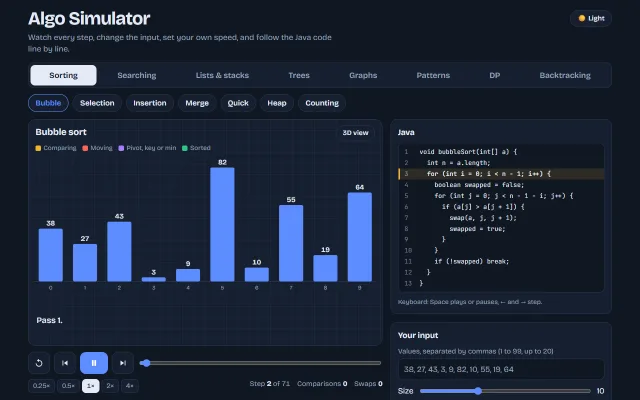
Algo Simulator
Watch sorting, searching, trees, heaps and graph algorithms run one step at a time, with animated visuals you can pause and replay.
Computer Science · Algorithms, Data Structures
Class 11–12 · College & beyond Class 11–12 Computer Science: searching, sorting and stacks
Launch simulator : Algo Simulator
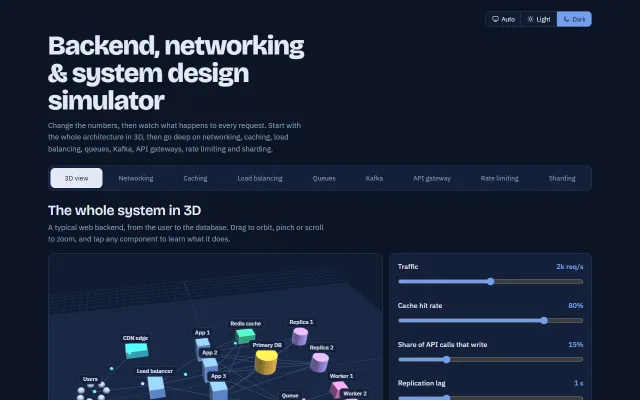
System Design Simulator
Build architectures from load balancers, caches, queues and databases, then watch traffic flow and see where they break.
Computer Science · System Design, Computer Networks
College & beyond Software engineering: system design
Launch simulator : System Design Simulator
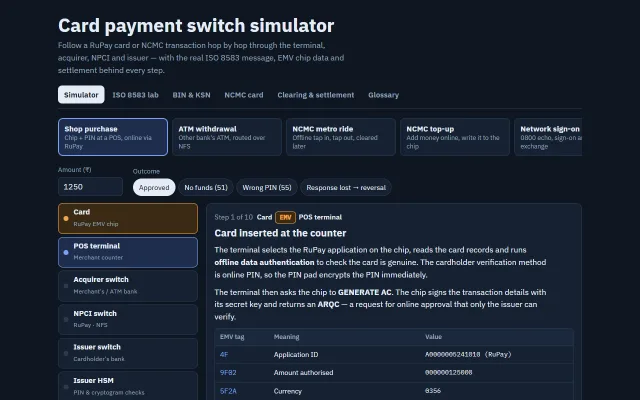
Card Payment Switch Simulator
Follow a card transaction from the terminal through the payment switch to the issuing bank and back, including ISO 8583 messages and NCMC.
Payments & Finance · Card Payments, ISO 8583, Payment Switching, NCMC
College & beyond Payments and banking systems
Launch simulator : Card Payment Switch Simulator
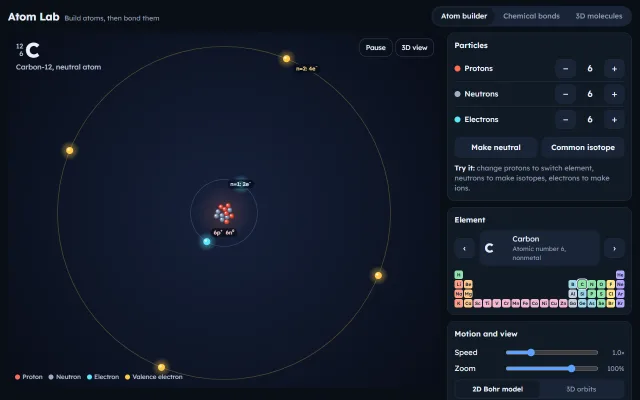
Atom Lab
Build atoms by adding protons, neutrons and electrons, and see how the element, charge and isotope change.
Physics · Atomic & Nuclear, Atomic Structure
Class 9–10 · Class 11–12 Class 9 Science: Structure of the Atom; Class 11 Chemistry: Structure of Atom
Launch simulator : Atom Lab
Projectile Motion
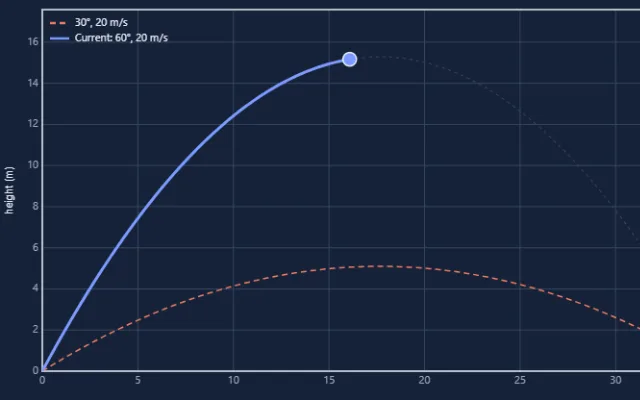
Launch a projectile, change angle, speed, gravity, height and air drag, and compare trajectories, range and flight time.
Physics · Mechanics
Class 11–12 Class 11 Physics: Motion in a Plane
Launch simulator : Projectile Motion
Pendulum
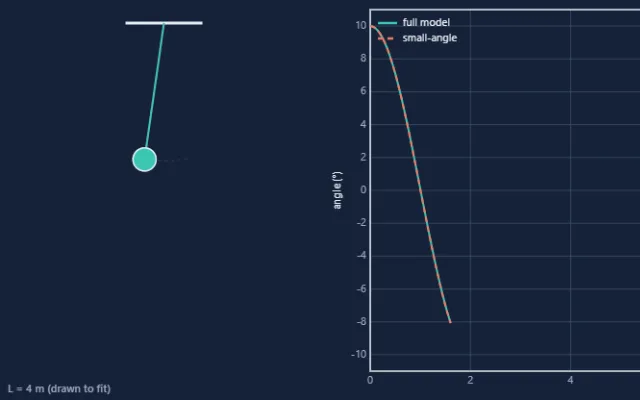
Swing a simple pendulum, change length, gravity, amplitude and damping, and compare the measured period with the small-angle formula.
Physics · Mechanics, Waves & Sound
Class 6–8 · Class 11–12 Class 7 Science: measurement of time and motion; Class 11 Physics: Oscillations
Launch simulator : Pendulum
Spring and Mass
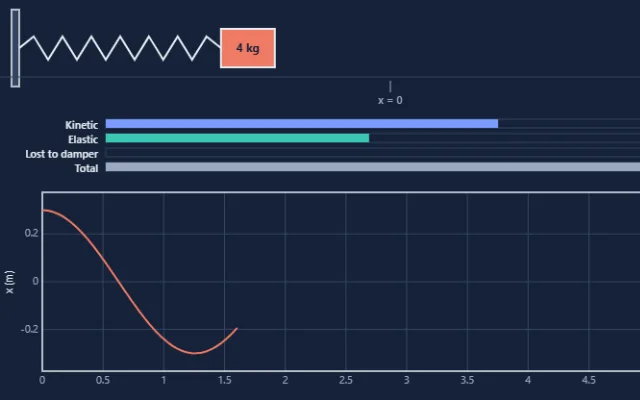
Oscillate a mass on a spring, change mass, stiffness and damping, and watch kinetic, elastic and lost energy trade places.
Physics · Mechanics
Class 11–12 Class 11 Physics: Oscillations
Launch simulator : Spring and Mass
Collisions
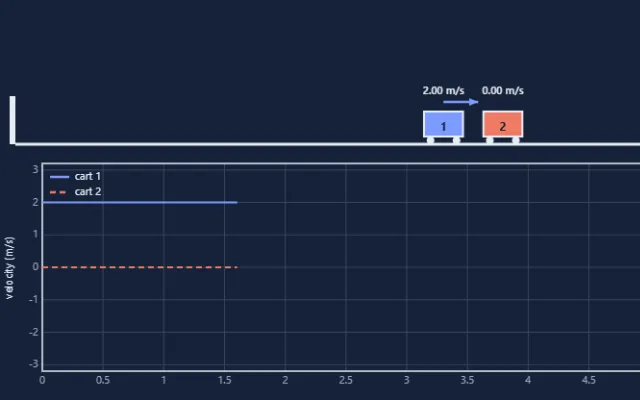
Collide two carts on a track, change their masses, velocities and restitution, and check momentum and kinetic energy before and after.
Physics · Mechanics
Class 9–10 · Class 11–12 Class 9 Science: Force and Laws of Motion (momentum); Class 11 Physics: Work, Energy and Power
Launch simulator : Collisions
Inclined Plane
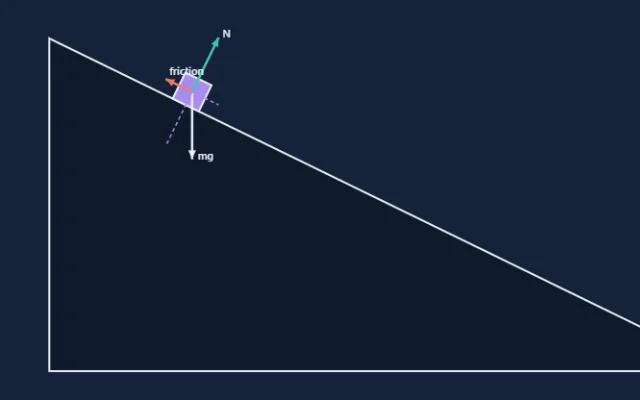
Put a block on a ramp, change slope, mass and friction, resolve the forces and predict whether it slides.
Physics · Mechanics
Class 11–12 Class 11 Physics: Laws of Motion (friction, resolving forces)
Launch simulator : Inclined Plane
Circular Motion
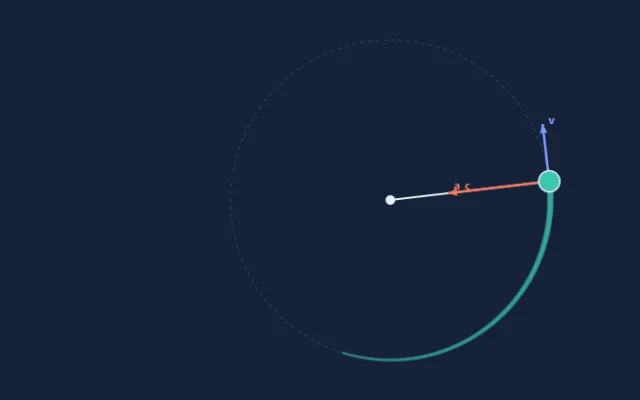
Spin an object around a circle, change radius, speed and mass, and inspect centripetal acceleration, force and what happens when the string is cut.
Physics · Mechanics
Class 11–12 Class 11 Physics: Motion in a Plane; Laws of Motion
Launch simulator : Circular Motion
Orbital Motion
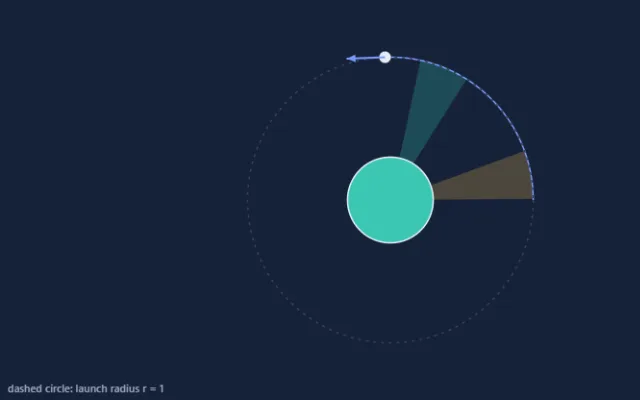
Launch a satellite around a planet, change its starting speed and direction, and compare circular, elliptical and escape trajectories.
Physics · Mechanics
Class 9–10 · Class 11–12 Class 9 Science: Gravitation; Class 11 Physics: Gravitation
Launch simulator : Orbital Motion
Wave Interference
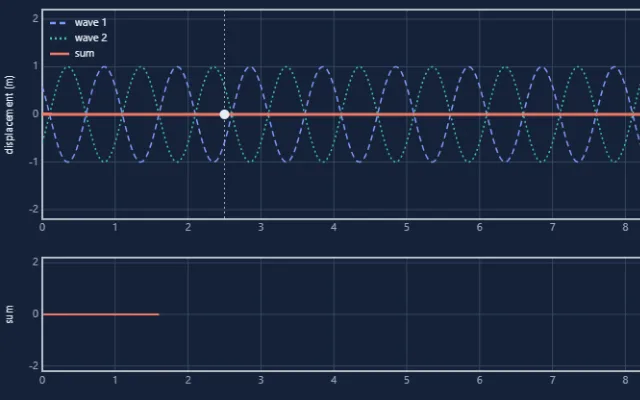
Add two travelling waves, change their amplitude, frequency and phase, and watch superposition create constructive, destructive interference and beats.
Physics · Waves & Sound
Class 11–12 Class 12 Physics: Wave Optics
Launch simulator : Wave Interference
Standing Waves
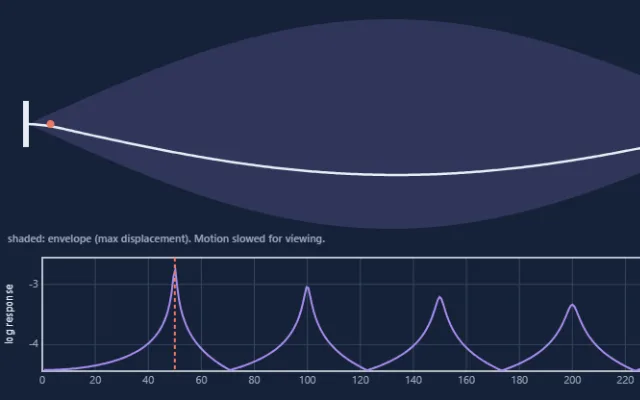
Drive a string fixed at both ends, change length, tension, density and frequency, and find the resonant harmonics.
Physics · Waves & Sound
Class 11–12 Class 11 Physics: Waves
Launch simulator : Standing Waves
Doppler Effect
Move a sound source and a listener, watch wavefronts bunch up and spread out, and compare emitted and received frequency.
Physics · Waves & Sound
Class 11–12 · College & beyond Class 11 Physics: Waves
Launch simulator : Doppler Effect
Geometric Optics
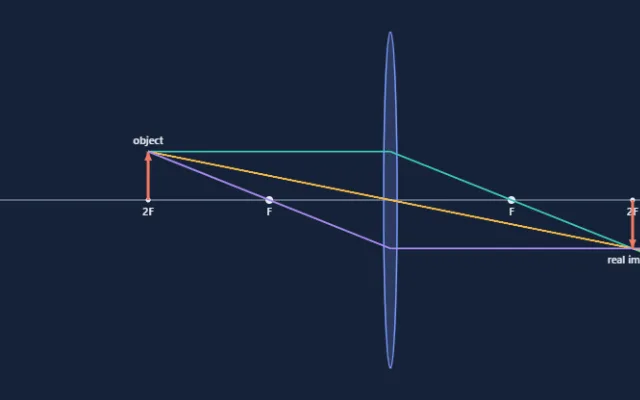
Drag an object in front of a thin lens, change the focal length, and trace the principal rays to find the image position, size and type.
Physics · Optics
Class 9–10 · Class 11–12 Class 10 Science: Light – Reflection and Refraction; Class 12 Physics: Ray Optics
Launch simulator : Geometric Optics
Refraction
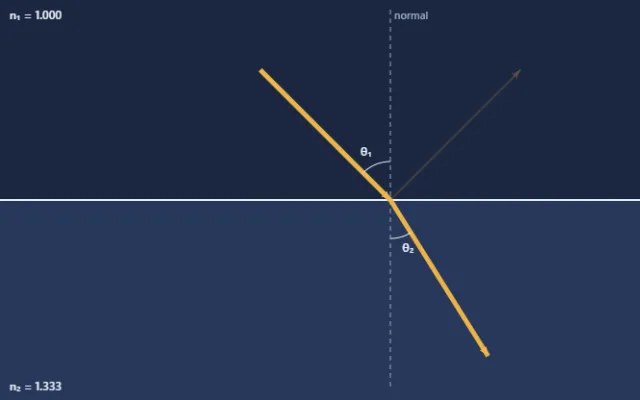
Shine a ray between two media, change refractive indices and incidence angle, and find the critical angle and total internal reflection.
Physics · Optics
Class 9–10 · Class 11–12 Class 10 Science: Light – Reflection and Refraction; Class 12 Physics: Ray Optics
Launch simulator : Refraction
Heat Diffusion
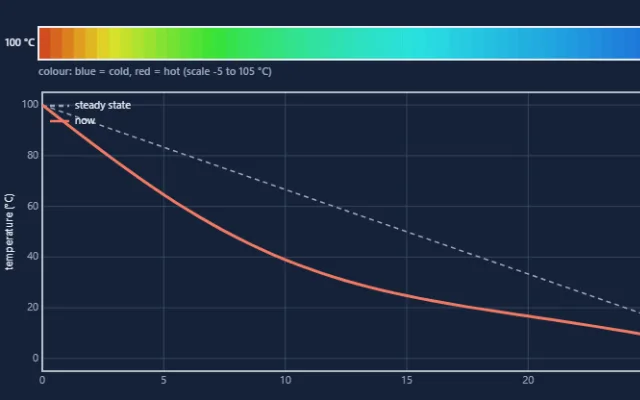
Heat a metal rod, choose the material and end temperatures, and watch the temperature profile relax towards a straight-line steady state.
Physics · Heat & Gases
Class 6–8 · Class 11–12 Class 7 Science: heat and conduction; Class 11 Physics: Thermal Properties of Matter
Launch simulator : Heat Diffusion
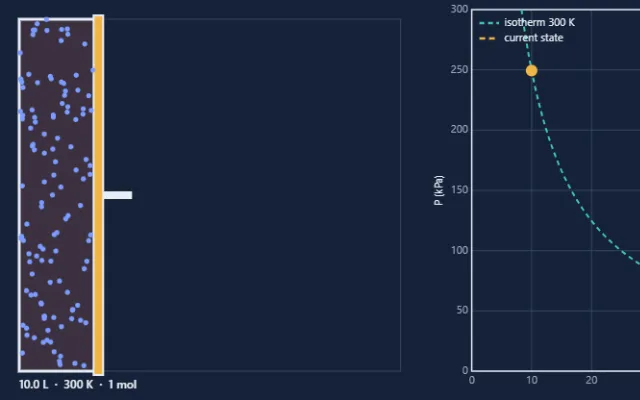
Gas Laws
Squeeze, heat and fill a piston of bouncing particles, hold one quantity constant, and see Boyle's, Charles's and Gay-Lussac's laws emerge.
Physics · Heat & Gases
Class 11–12 Class 11 Physics: Kinetic Theory (gas laws)
Launch simulator : Gas Laws
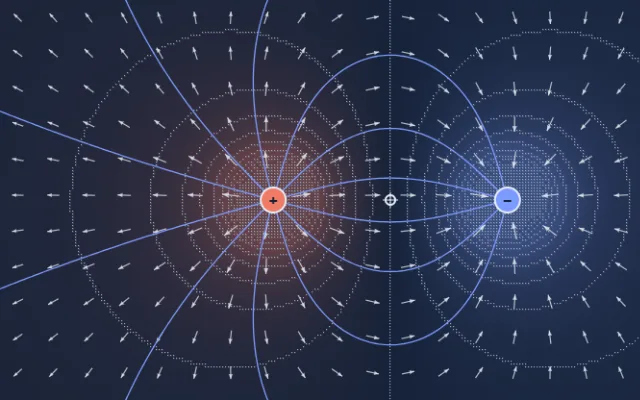
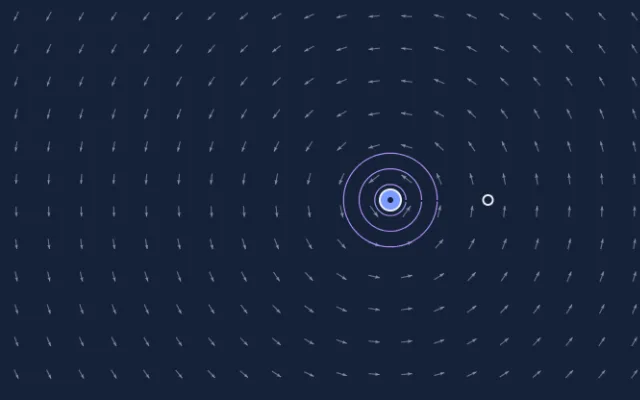
Electric Fields
Place and drag positive and negative charges, and visualise the electric field vectors, field lines and equipotential contours they create.
Physics · Electricity & Magnetism
Class 11–12 Class 12 Physics: Electric Charges and Fields
Launch simulator : Electric Fields
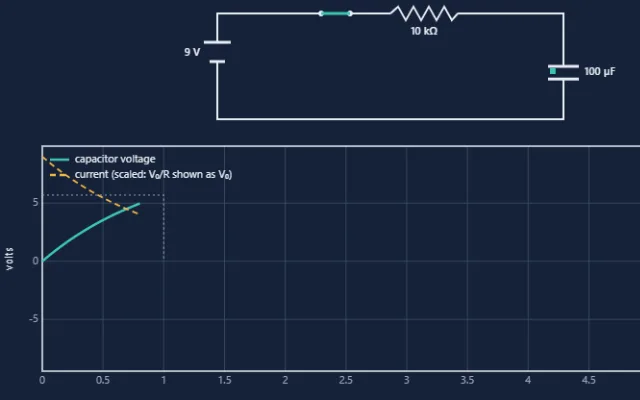
RC Circuit
Charge and discharge a capacitor through a resistor, change R, C and the supply voltage, and read the time constant from the exponential curves.
Engineering · Circuits & Electronics
Class 11–12 · College & beyond Class 12 Physics: Electrostatic Potential and Capacitance
Launch simulator : RC Circuit
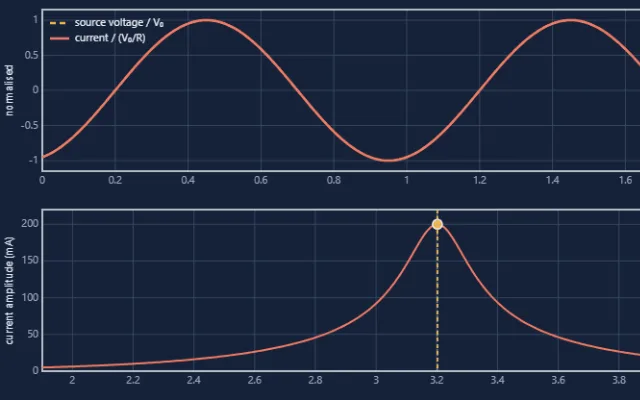
RLC Resonance
Drive a series RLC circuit with an AC source, sweep the frequency, and inspect current amplitude, phase and the sharpness of resonance.
Engineering · Circuits & Electronics
Class 11–12 · College & beyond Class 12 Physics: Alternating Current (resonance)
Launch simulator : RLC Resonance
Electromagnetic Induction
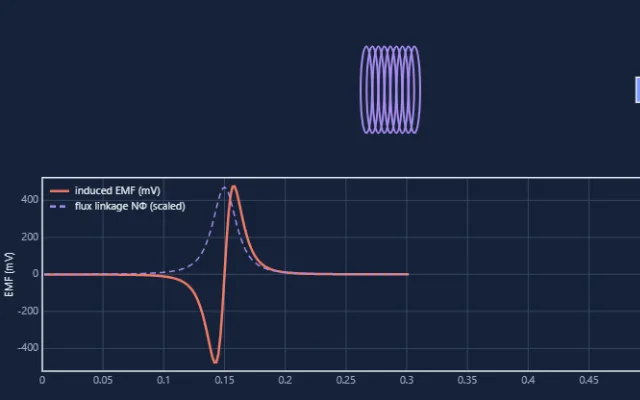
Push a bar magnet through a coil, change speed, turns and magnet strength, and connect the changing magnetic flux to the induced voltage.
Physics · Electricity & Magnetism
Class 11–12 Class 12 Physics: Electromagnetic Induction
Launch simulator : Electromagnetic Induction
Fluid Continuity
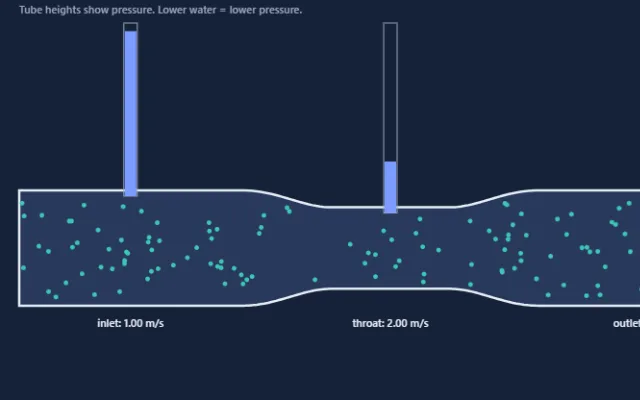
Push water through a pipe that narrows and widens, change areas and flow rate, and compare speed and idealised pressure along the pipe.
Physics · Fluids
Class 11–12 Class 11 Physics: Mechanical Properties of Fluids
Launch simulator : Fluid Continuity
Buoyancy
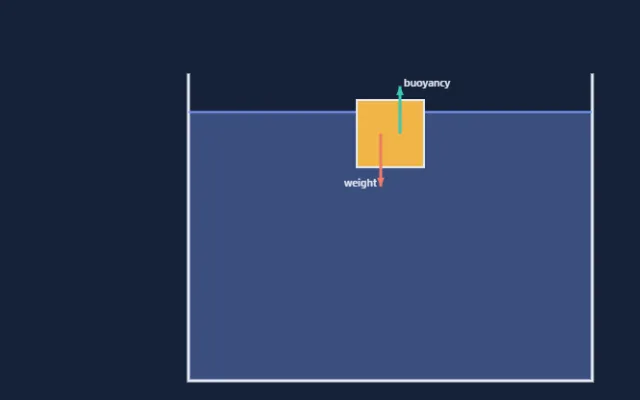
Drop blocks of different densities into different liquids, predict whether they float and how deep, and see Archimedes' principle balance the forces.
Physics · Fluids
Class 9–10 · Class 11–12 Class 9 Science: Gravitation (thrust, buoyancy, Archimedes' principle); Class 11 Physics: Fluids
Launch simulator : Buoyancy
Reaction Rates
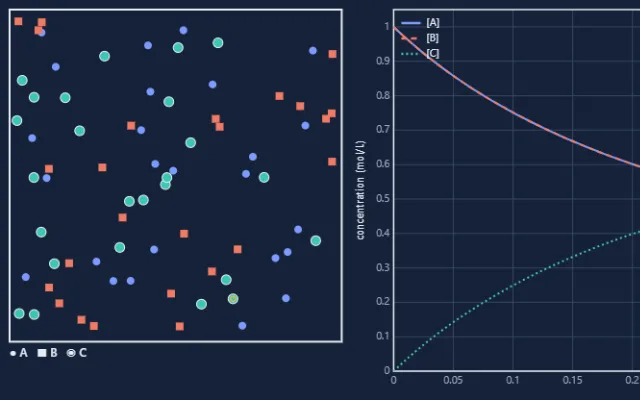
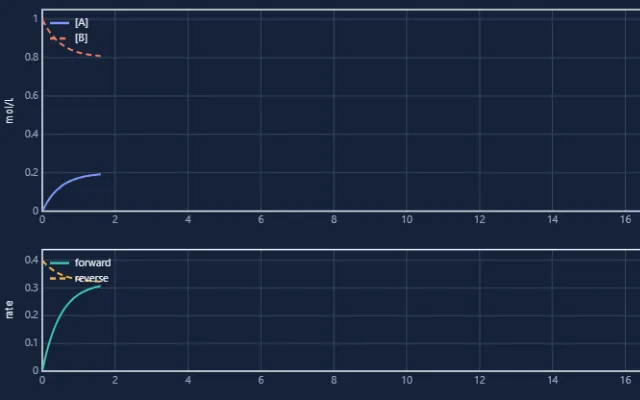
Run a reaction A + B → C, change temperature, concentration and activation energy, and compare particle collisions with the rate law and Arrhenius equation.
Chemistry · Kinetics & Equilibrium
Class 11–12 Class 12 Chemistry: Chemical Kinetics
Launch simulator : Reaction Rates
Chemical Equilibrium
Run a reversible reaction A ⇌ B to equilibrium, then add reactant, remove product or change temperature, and watch Le Chatelier's principle at work.
Chemistry · Kinetics & Equilibrium
Class 11–12 Class 11 Chemistry: Equilibrium
Launch simulator : Chemical Equilibrium
Acid–Base Titration
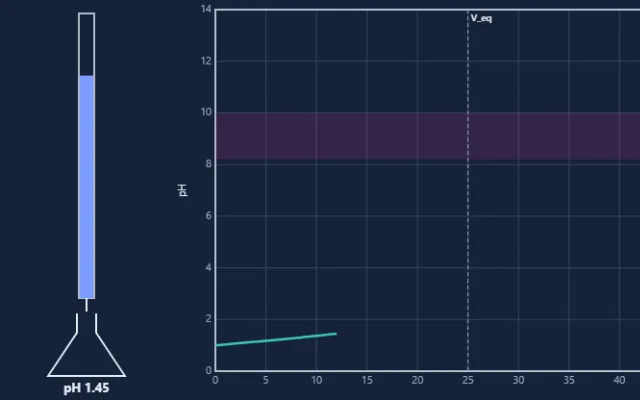
Add base from a burette to an acid, graph the pH curve, and identify the equivalence point, buffer region and a suitable indicator.
Chemistry · Acids & Bases
Class 9–10 · Class 11–12 Class 10 Science: Acids, Bases and Salts; Class 11 Chemistry: Equilibrium (ionic)
Launch simulator : Acid–Base Titration
Molecular Diffusion
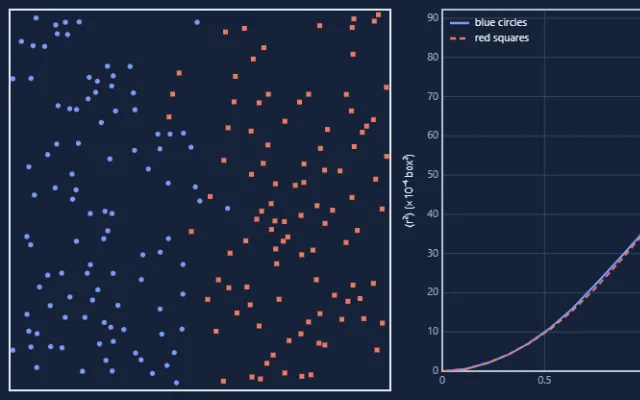
Release two gases on either side of a barrier, change temperature and particle count, and compare mixing with random-walk displacement statistics.
Chemistry · Thermochemistry & Mixtures
Class 6–8 · Class 9–10 Class 9 Science: Matter in Our Surroundings (diffusion)
Launch simulator : Molecular Diffusion
Electrochemical Cell
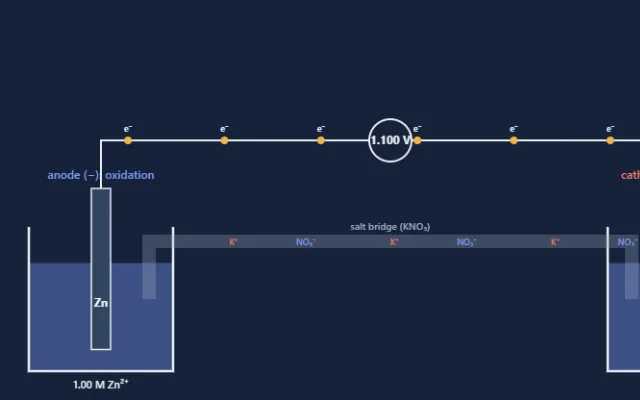
Build a galvanic cell from two half-cells, find the anode, follow electron and ion flow, and work out the voltage with the Nernst equation.
Chemistry · Electrochemistry
Class 11–12 Class 12 Chemistry: Electrochemistry
Launch simulator : Electrochemical Cell
Chromatography
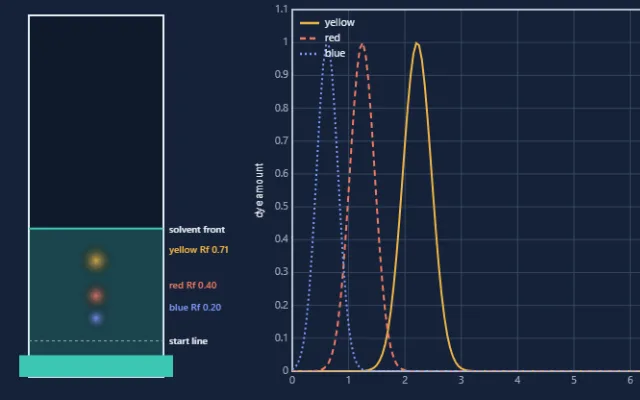
Spot a mixture on a strip, change each dye's affinity and the solvent flow, and watch components separate by retention factor.
Chemistry · Separation
Class 6–8 · Class 9–10 · Class 11–12 Class 6 Science: separating substances; Class 11 Chemistry: methods of purification
Launch simulator : Chromatography
Radioactive Decay
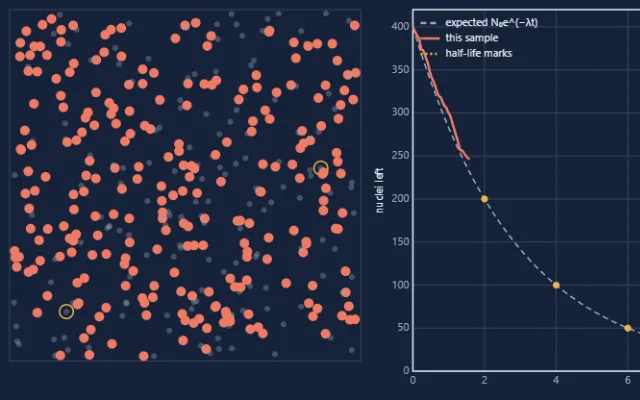
Watch a sample of unstable nuclei decay at random, change half-life and starting count, and compare the stochastic count with the exponential expectation.
Physics · Atomic & Nuclear
Class 11–12 · College & beyond Class 12 Physics: Nuclei
Launch simulator : Radioactive Decay
Calorimetry
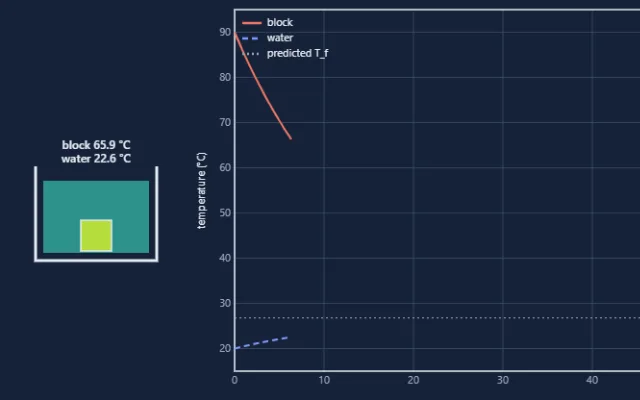
Drop a hot metal into water in an insulated cup, change masses, materials and temperatures, and solve the energy balance for the final temperature.
Chemistry · Thermochemistry & Mixtures
Class 11–12 Class 11 Physics: Thermal Properties of Matter; Class 11 Chemistry: Thermodynamics
Launch simulator : Calorimetry
Solubility
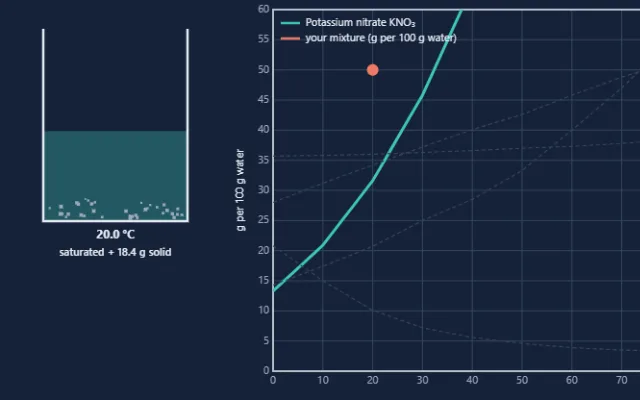
Dissolve salts in water, change temperature and amount, and see when a solution becomes saturated and excess solid remains or crystallises out.
Chemistry · Thermochemistry & Mixtures
Class 9–10 · Class 11–12 Class 9 Science: Is Matter Around Us Pure (solutions); Class 12 Chemistry: Solutions
Launch simulator : Solubility
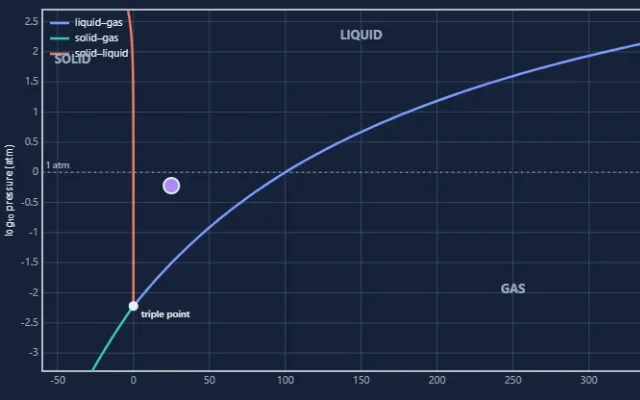
Phase Diagram
Move a sample of water or carbon dioxide around its pressure–temperature phase diagram and see where it is solid, liquid, gas or supercritical.
Chemistry · Thermochemistry & Mixtures
Class 11–12 · College & beyond Extends Class 9 states of matter; phase diagrams are college level
Launch simulator : Phase Diagram
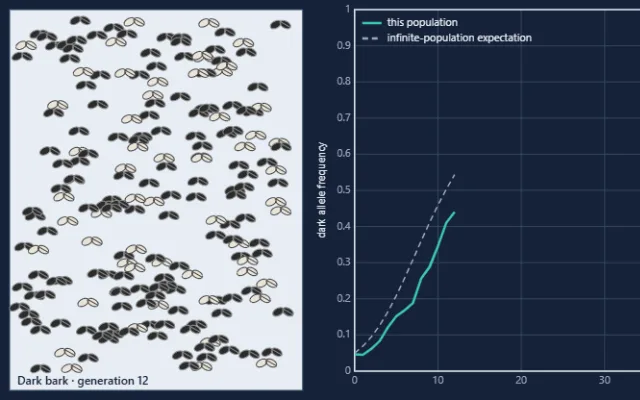
Natural Selection
Evolve a population of moths on light and dark bark, change the selection pressure and mutation rate, and track trait frequencies across generations.
Biology · Evolution & Genetics
Class 11–12 Class 12 Biology: Evolution
Launch simulator : Natural Selection
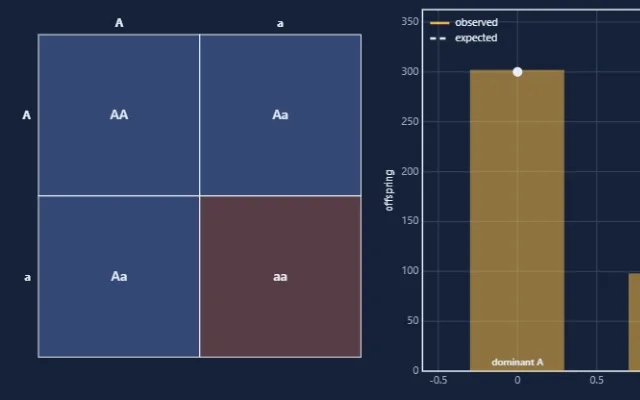
Genetic Crosses
Choose parental alleles for one or two genes, build the Punnett square, and compare expected offspring ratios with a random sample of offspring.
Biology · Evolution & Genetics
Class 9–10 · Class 11–12 Class 10 Science: Heredity; Class 12 Biology: Principles of Inheritance and Variation
Launch simulator : Genetic Crosses
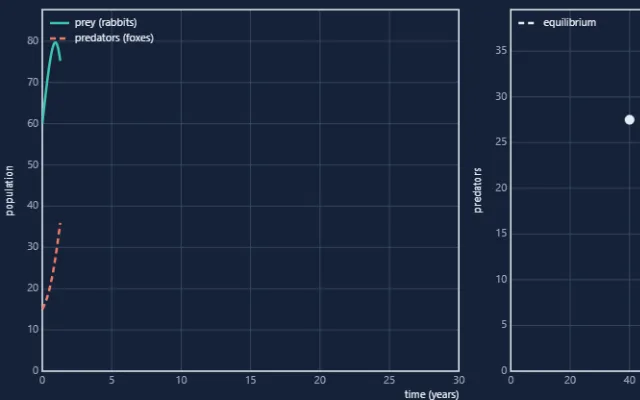
Predator and Prey
Model rabbits and foxes with the Lotka–Volterra equations, change growth and predation rates, and inspect population cycles and the phase-plane orbit.
Biology · Ecology
Class 11–12 · College & beyond Class 12 Biology: Organisms and Populations (population interactions)
Launch simulator : Predator and Prey
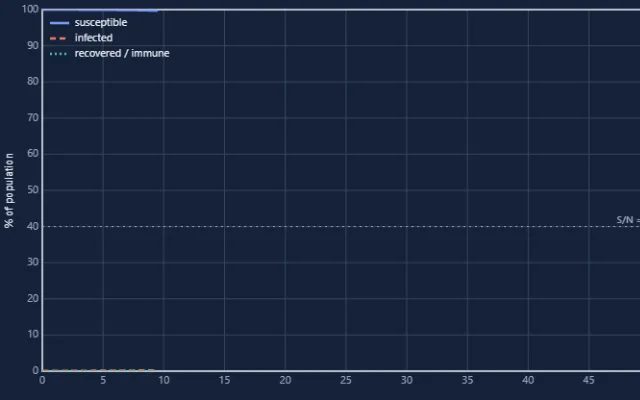
Epidemic Dynamics
Run the SIR model of an epidemic, change transmission, recovery and vaccination, and compare peak size, timing and final outbreak size.
Biology · Ecology
Class 11–12 · College & beyond Class 12 Biology: Human Health and Disease; the SIR model is college level
Launch simulator : Epidemic Dynamics
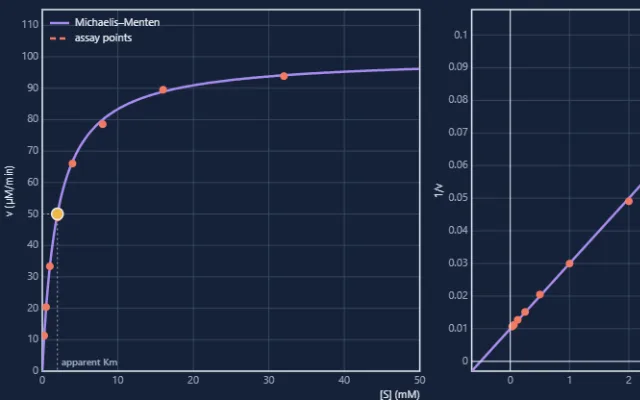
Enzyme Kinetics
Change substrate concentration, Vmax, Km and inhibitor type, and read reaction velocity curves and Lineweaver–Burk plots.
Biology · Cells & Physiology
Class 11–12 · College & beyond Class 11 Biology: Biomolecules (enzymes)
Launch simulator : Enzyme Kinetics
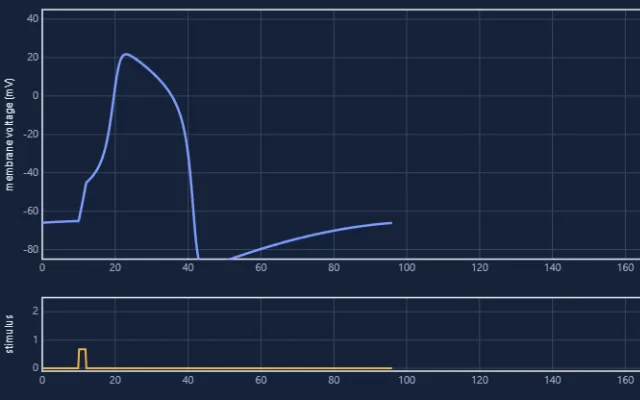
Neuron Signals
Stimulate a model neuron, change stimulus strength and membrane properties, and watch threshold, action potentials, refractory periods and firing rate.
Biology · Cells & Physiology
Class 9–10 · Class 11–12 · College & beyond Class 10 Science: Control and Coordination; Class 11 Biology: Neural Control and Coordination
Launch simulator : Neuron Signals
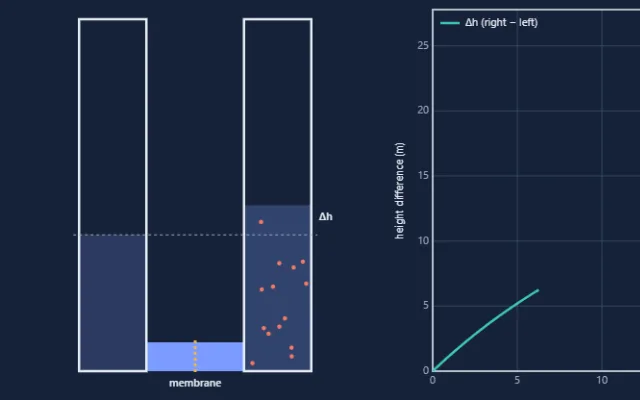
Osmosis
Separate two solutions with a semi-permeable membrane, change concentrations and permeability, and watch net water movement and osmotic pressure.
Biology · Cells & Physiology
Class 9–10 · Class 11–12 Class 9 Science: The Fundamental Unit of Life (osmosis); Class 12 Chemistry: Solutions (osmotic pressure)
Launch simulator : Osmosis
Photosynthesis
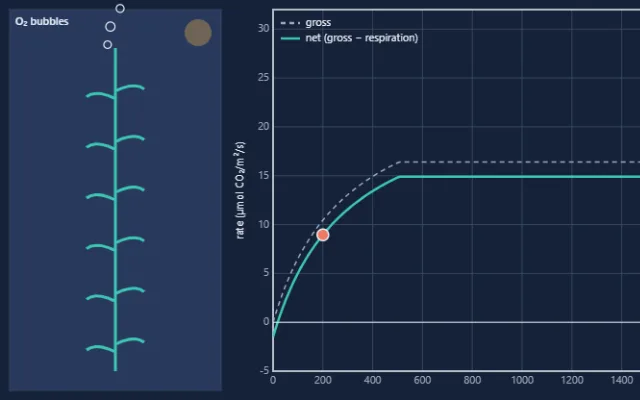
Adjust light intensity, carbon dioxide and temperature for a leaf, and explore which factor limits the rate of photosynthesis.
Biology · Cells & Physiology
Class 6–8 · Class 9–10 · Class 11–12 Class 7 Science: nutrition in plants; Class 10 Science: Life Processes; Class 11 Biology: Photosynthesis in Higher Plants
Launch simulator : Photosynthesis
Food Web
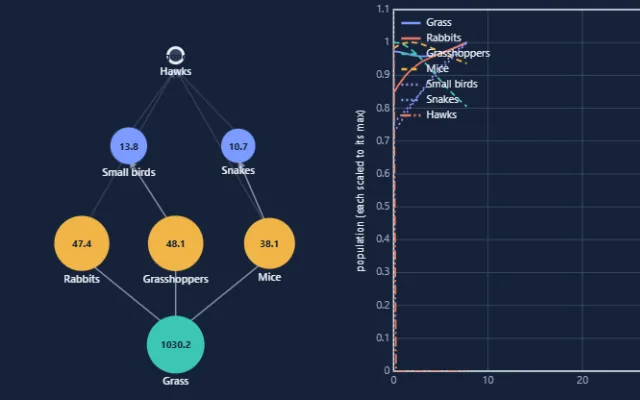
Change species populations in a small grassland food web and follow how a change in one species ripples through the others.
Biology · Ecology
Class 6–8 · Class 9–10 · Class 11–12 Class 10 Science: Our Environment (food chains and webs); Class 12 Biology: Ecosystem
Launch simulator : Food Web
Genetic Drift
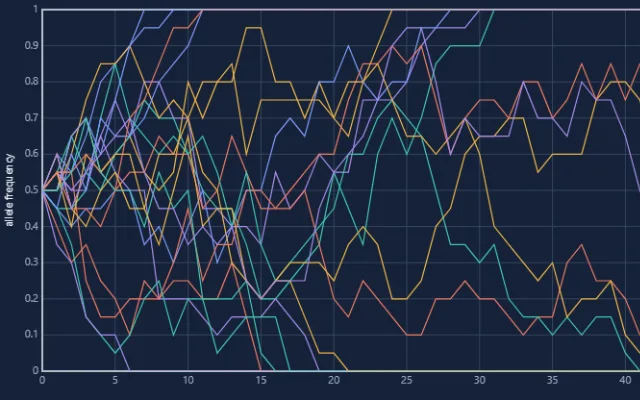
Run many populations at once under pure chance (Wright–Fisher model), change population size, and compare how fast alleles fix or vanish.
Biology · Evolution & Genetics
Class 11–12 · College & beyond Class 12 Biology: Evolution (Hardy–Weinberg, genetic drift)
Launch simulator : Genetic Drift
Derivative Explorer
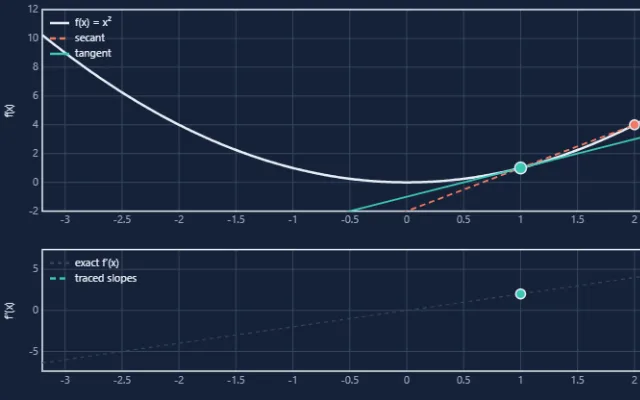
Move a point along a curve and shrink the secant interval to see the secant slope approach the derivative, with the derivative curve traced live.
Mathematics · Calculus
Class 11–12 Class 11 Maths: Limits and Derivatives; Class 12 Maths: Application of Derivatives
Launch simulator : Derivative Explorer
Integral Explorer
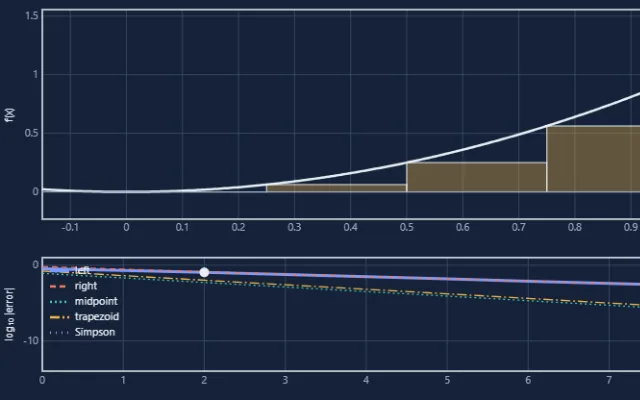
Approximate the area under a curve with left, right, midpoint and trapezoid sums, change partitions and bounds, and watch the error shrink.
Mathematics · Calculus
Class 11–12 Class 12 Maths: Integrals; Application of Integrals
Launch simulator : Integral Explorer
Fourier Synthesis
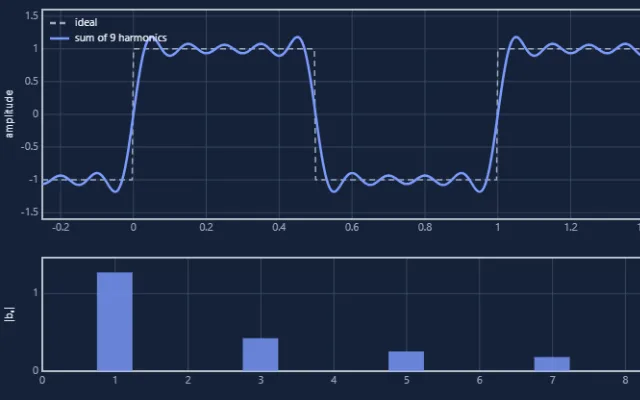
Build square, sawtooth and triangle waves by adding sine harmonics, inspect the spectrum, and see the Gibbs overshoot at jumps.
Mathematics · Calculus
College & beyond Fourier series: college mathematics and engineering
Launch simulator : Fourier Synthesis
Linear Transformations
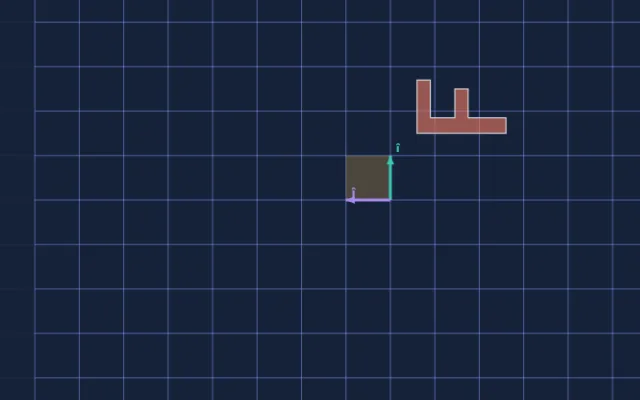
Edit a 2×2 matrix and watch it transform a grid, the basis vectors and a shape, with determinant, eigenvectors and animation from the identity.
Mathematics · Linear Algebra
Class 11–12 · College & beyond Class 12 Maths: Matrices
Launch simulator : Linear Transformations
Complex Plane
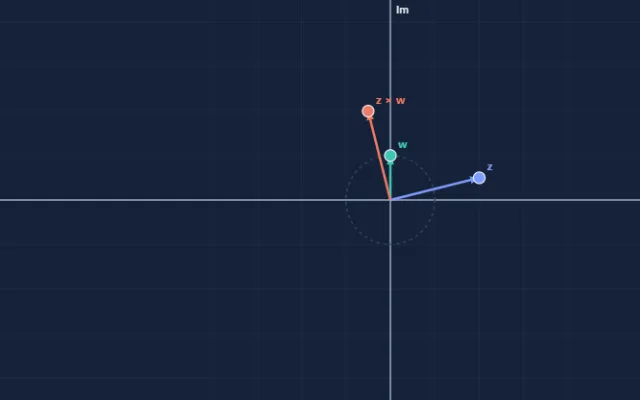
Drag two complex numbers on the Argand plane and see addition as vector sum, multiplication as rotate-and-scale, and powers and roots as spirals.
Mathematics · Linear Algebra
Class 11–12 Class 11 Maths: Complex Numbers
Launch simulator : Complex Plane
Gradient Descent
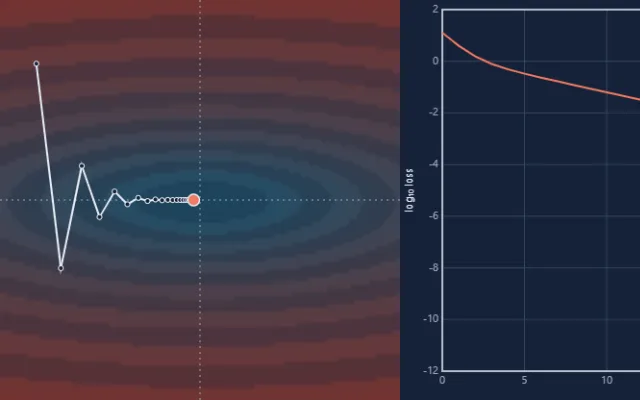
Roll down a loss landscape with gradient descent, change the learning rate, start point and momentum, and see convergence, oscillation and divergence.
Mathematics · Calculus
Class 11–12 · College & beyond Builds on Class 12 Maths: Application of Derivatives (maxima and minima)
Launch simulator : Gradient Descent
Probability Distributions
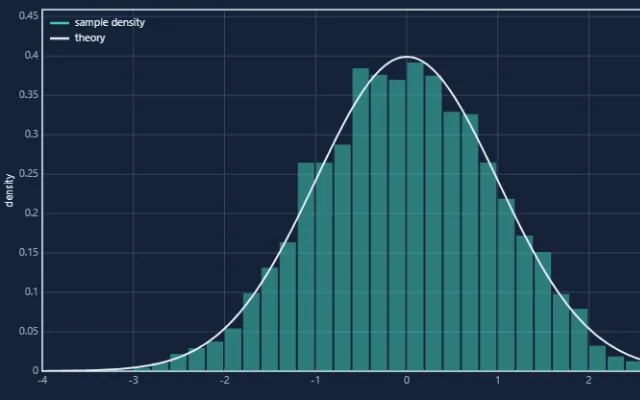
Pick a distribution, change its parameters, draw random samples and compare the histogram with the theoretical curve, mean and spread.
Mathematics · Probability & Statistics
Class 11–12 · College & beyond Class 12 Maths: Probability
Launch simulator : Probability Distributions
Central Limit Theorem
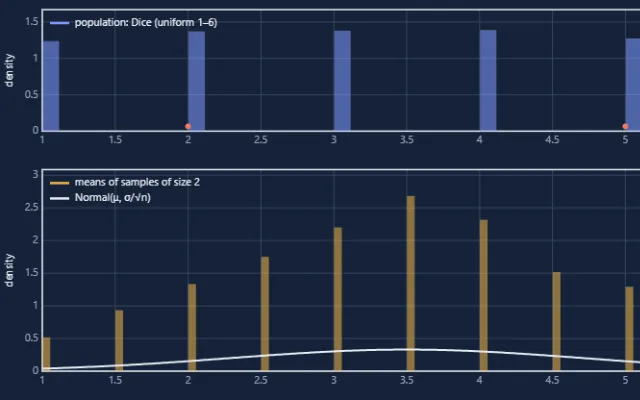
Take repeated samples from skewed or lumpy distributions, plot the sample means, and watch them form a normal curve as the sample size grows.
Mathematics · Probability & Statistics
College & beyond College statistics
Launch simulator : Central Limit Theorem
Bayesian Updating
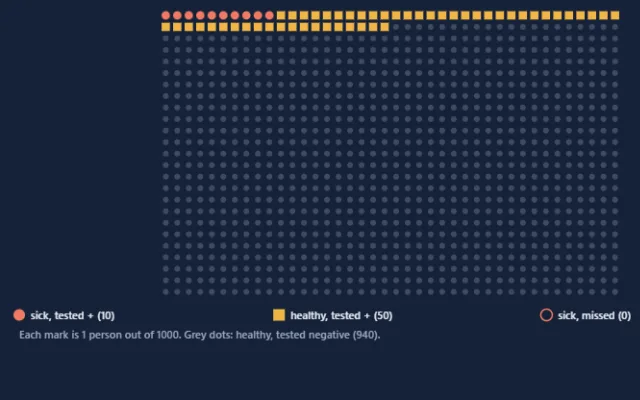
Set a prior, observe evidence such as test results or coin flips, and watch the posterior probability update with Bayes' theorem.
Mathematics · Probability & Statistics
Class 11–12 · College & beyond Class 12 Maths: Probability (Bayes' theorem)
Launch simulator : Bayesian Updating
Monte Carlo Estimation
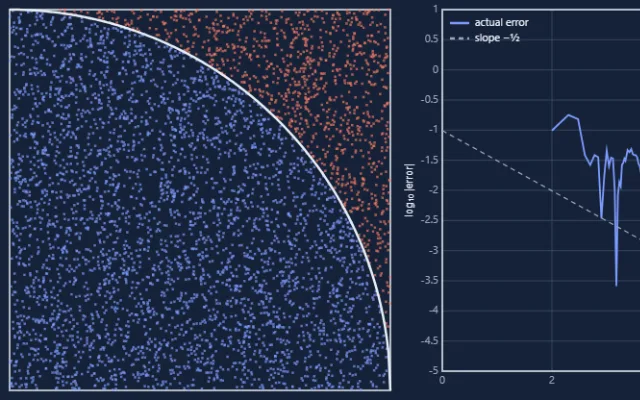
Throw random points to estimate π or the area under a curve, and watch the error shrink with the square root of the sample count.
Mathematics · Probability & Statistics
Class 9–10 · Class 11–12 Class 10 Maths: Probability (estimating π with random points)
Launch simulator : Monte Carlo Estimation
Regression
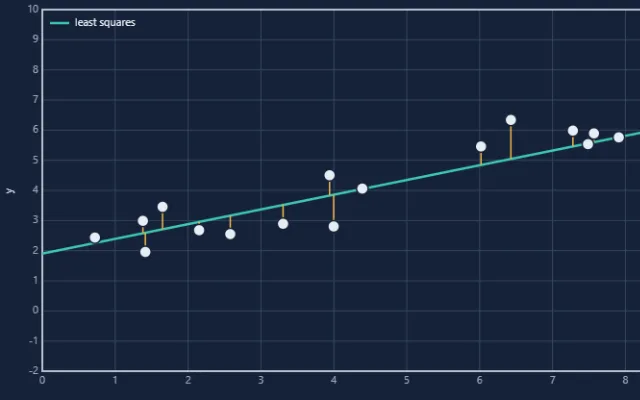
Add, drag and delete data points and watch the least-squares line, residuals, R² and the pull of outliers update live.
Mathematics · Probability & Statistics
Class 11–12 · College & beyond Class 11 Economics: Statistics for Economics (correlation); regression is college level
Launch simulator : Regression
Hypothesis Testing
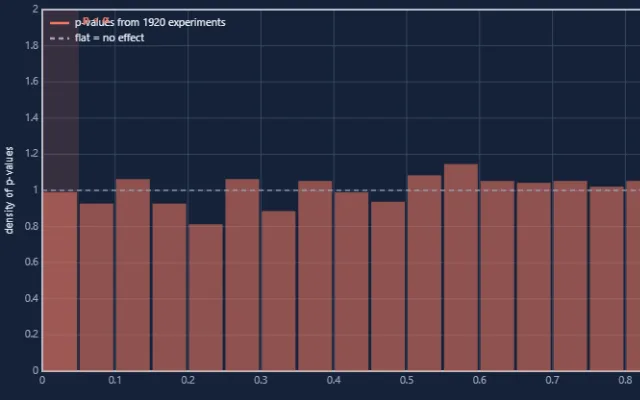
Simulate thousands of experiments, change effect size, sample size and significance level, and measure false positives, power and p-values.
Mathematics · Probability & Statistics
College & beyond College statistics
Launch simulator : Hypothesis Testing
Markov Chains
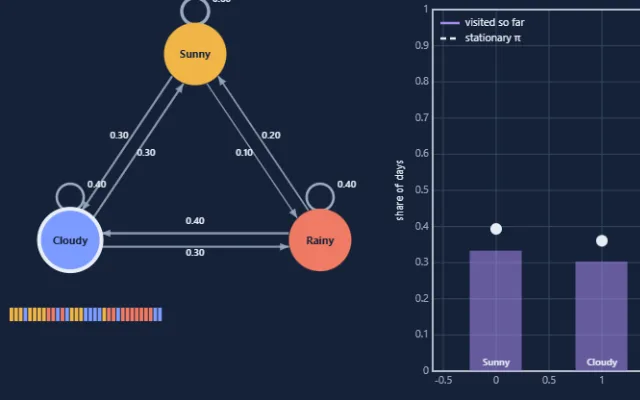
Edit transition probabilities between weather states, simulate a random walk through the chain, and compare visit frequencies with the stationary distribution.
Mathematics · Geometry & Dynamics
College & beyond College probability
Launch simulator : Markov Chains
Cellular Automata
Draw cells on a grid, set birth and survival rules, and watch Conway's Game of Life and other automata produce gliders, oscillators and chaos.
Computer Science · Emergence & Agents
College & beyond Beyond the syllabus: complex systems
Launch simulator : Cellular Automata
Fractals
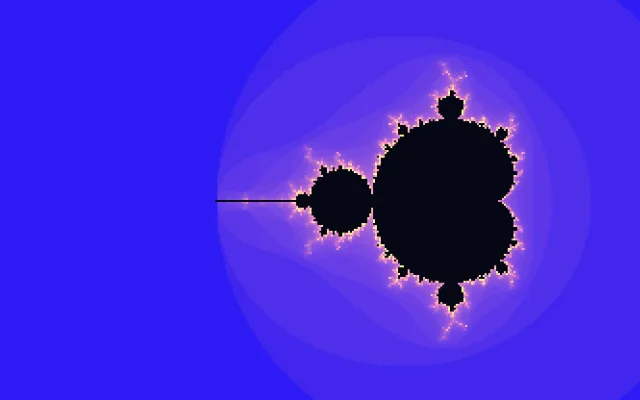
Explore the Mandelbrot set, Julia sets, the Koch snowflake and a fractal tree, changing iteration depth and parameters to see self-similar detail.
Mathematics · Geometry & Dynamics
Class 11–12 · College & beyond Builds on Class 11 Maths: Complex Numbers
Launch simulator : Fractals
Flocking
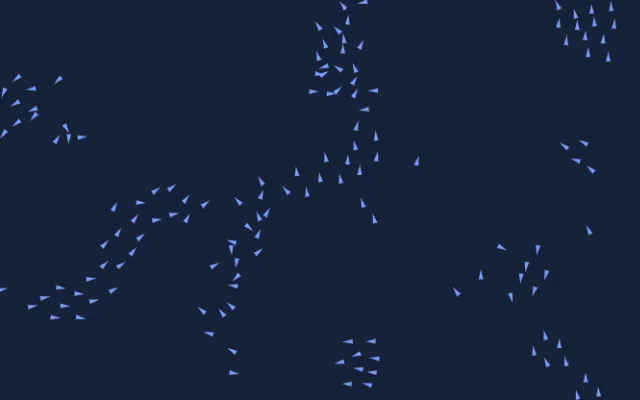
Tune separation, alignment and cohesion for a flock of boids and watch coordinated flocking emerge from simple local rules, with a predator option.
Computer Science · Emergence & Agents
College & beyond Beyond the syllabus: complex systems
Launch simulator : Flocking
RSA Cryptography
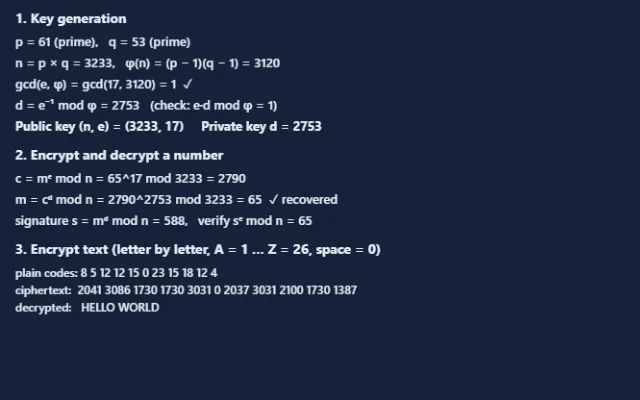
Generate a toy RSA key from two primes, encrypt and decrypt a message step by step, sign it, and see why factoring the modulus breaks the key.
Computer Science · Security & Coding
Class 11–12 · College & beyond Builds on Class 10 Maths: Real Numbers (primes); Class 11 Computer Science: cyber safety
Launch simulator : RSA Cryptography
Hash Tables
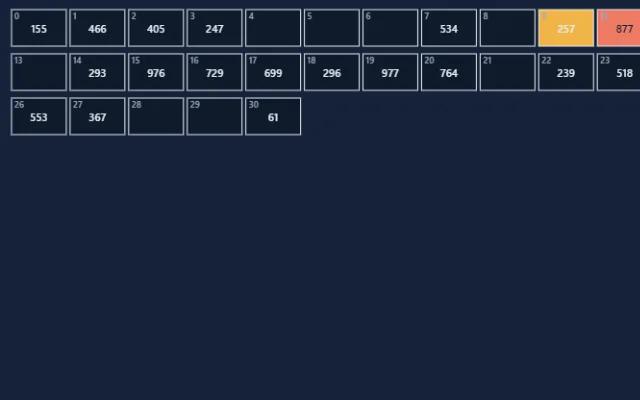
Insert keys into a hash table, compare chaining, linear and quadratic probing, and measure collisions and probes as the load factor grows.
Computer Science · Data Structures
College & beyond College data structures
Launch simulator : Hash Tables
Magnetic Fields
Place current-carrying wires and coils, and see the magnetic field lines, strength and direction they create, plus forces between parallel wires.
Physics · Electricity & Magnetism
Class 9–10 · Class 11–12 Class 10 Science: Magnetic Effects of Electric Current; Class 12 Physics: Moving Charges and Magnetism
Launch simulator : Magnetic Fields
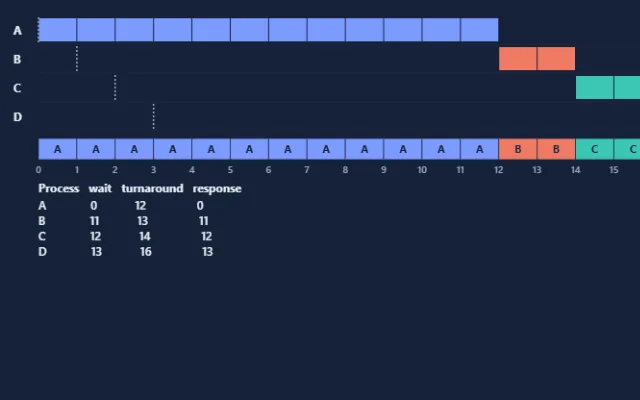
CPU Scheduling
Edit process arrival and burst times, then compare FCFS, SJF, SRTF, priority and round-robin schedules on a Gantt chart with waiting and turnaround times.
Computer Science · Operating Systems
College & beyond College operating systems
Launch simulator : CPU Scheduling
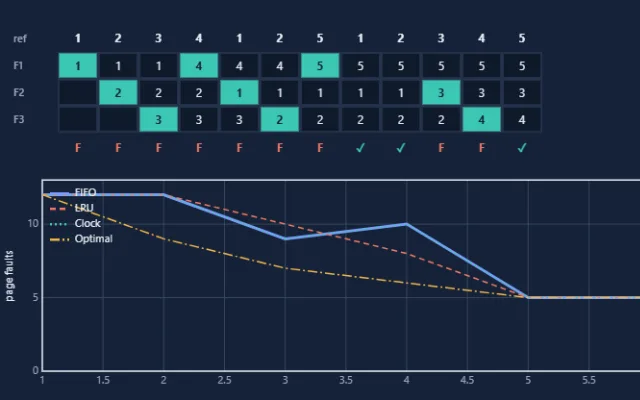
Page Replacement
Run a page reference string through FIFO, LRU, Optimal and Clock, change the frame count, and compare page faults, including Bélády's anomaly.
Computer Science · Operating Systems
College & beyond College operating systems
Launch simulator : Page Replacement
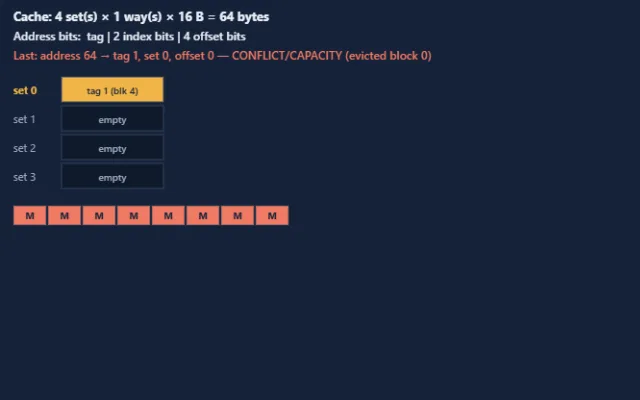
Cache Mapping
Send addresses through direct-mapped, set-associative and fully associative caches, see tag, index and offset bits, and compare hit rates.
Computer Science · Operating Systems
College & beyond College computer organisation
Launch simulator : Cache Mapping
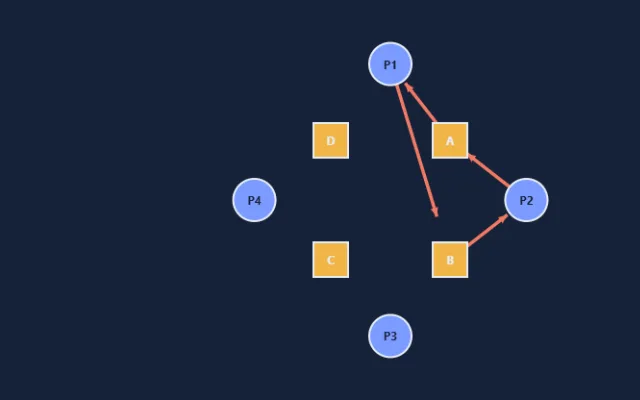
Deadlock
Assign resources to processes, draw the resource-allocation graph, detect cycles, and run the Banker's algorithm to find safe sequences.
Computer Science · Operating Systems
College & beyond College operating systems
Launch simulator : Deadlock
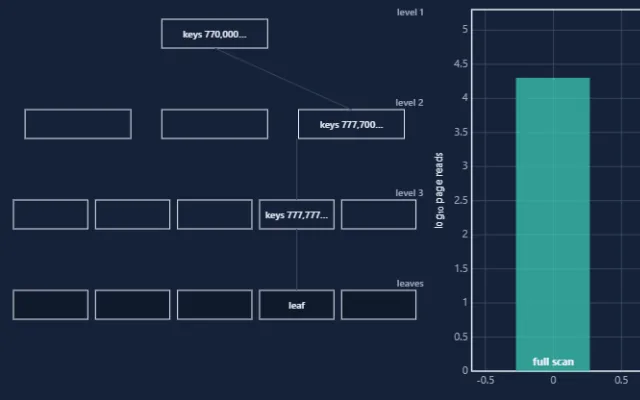
Database Indexes
Compare a full table scan with a B-tree index lookup on generated data, change table size and query selectivity, and count the rows and pages each one touches.
Computer Science · System Design, Data Structures
Class 11–12 · College & beyond Class 12 Computer Science: Database Concepts and SQL
Launch simulator : Database Indexes
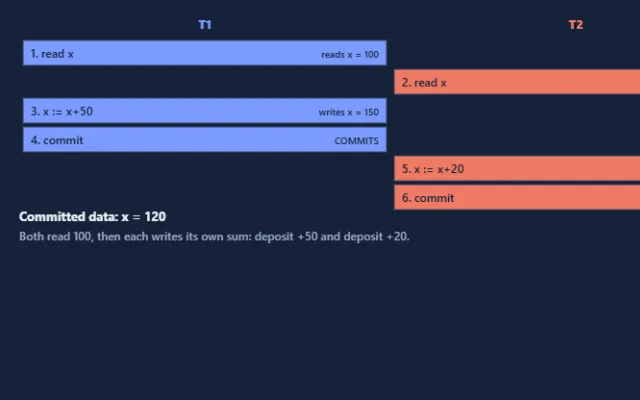
Transaction Isolation
Interleave two database transactions under different isolation levels and watch dirty reads, lost updates and write skew appear or get blocked.
Computer Science · System Design
College & beyond College databases
Launch simulator : Transaction Isolation
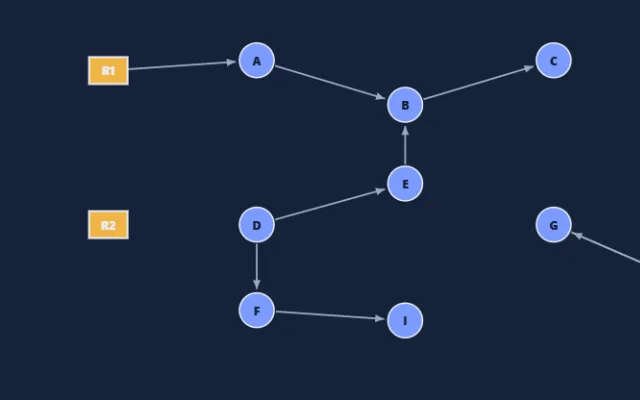
Garbage Collection
Build an object graph with roots and references, drop roots, and watch mark-and-sweep and reference counting find garbage, including leaked cycles.
Computer Science · Operating Systems
College & beyond College programming languages
Launch simulator : Garbage Collection
Compiler Pipeline
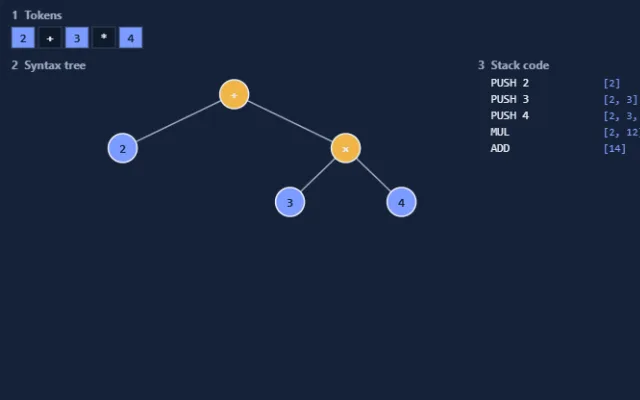
Type an arithmetic expression and follow it through tokenising, parsing into a syntax tree, stack-machine code and evaluation.
Computer Science · Algorithms
College & beyond College compilers
Launch simulator : Compiler Pipeline
Logic Gates
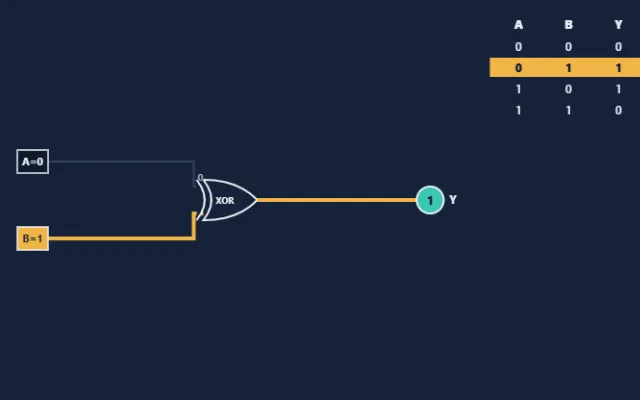
Toggle inputs on digital circuits from single gates to a half adder, full adder and SR latch, trace signal propagation, and generate truth tables.
Computer Science · Algorithms
Class 11–12 · College & beyond Class 11 Computer Science: Computer Systems (Boolean logic)
Launch simulator : Logic Gates
Finite State Machines
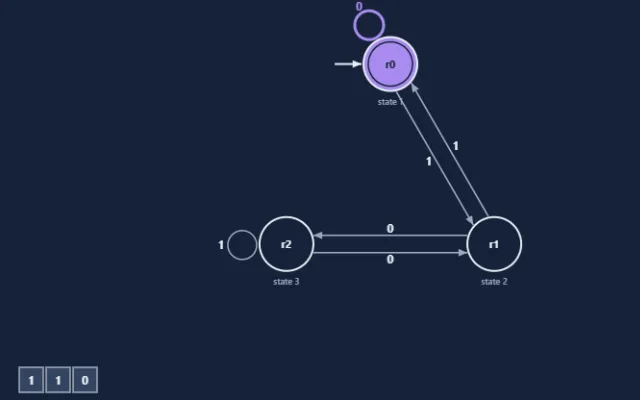
Step a deterministic finite automaton through an input string, edit its transitions, and see which strings it accepts, from binary divisibility to turnstiles.
Computer Science · Algorithms
College & beyond College theory of computation
Launch simulator : Finite State Machines
Error-Correcting Codes
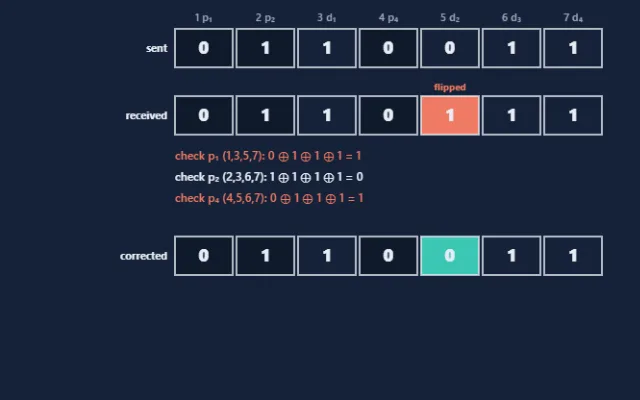
Encode 4 data bits with Hamming(7,4), flip bits in transit, compute the syndrome, and see single errors corrected and the limits when two bits flip.
Computer Science · Security & Coding
College & beyond College networks and coding theory
Launch simulator : Error-Correcting Codes
Queueing Systems
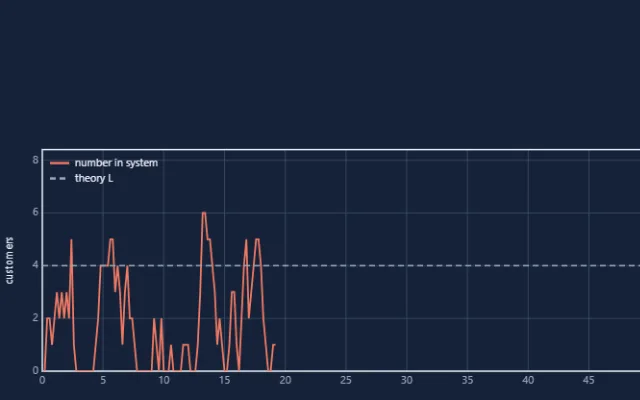
Simulate random arrivals at one or more servers, change arrival and service rates, and compare queue length and waiting time with M/M/c theory.
Operations & Economics · Queues & Flow
College & beyond College operations research
Launch simulator : Queueing Systems
Inventory Control
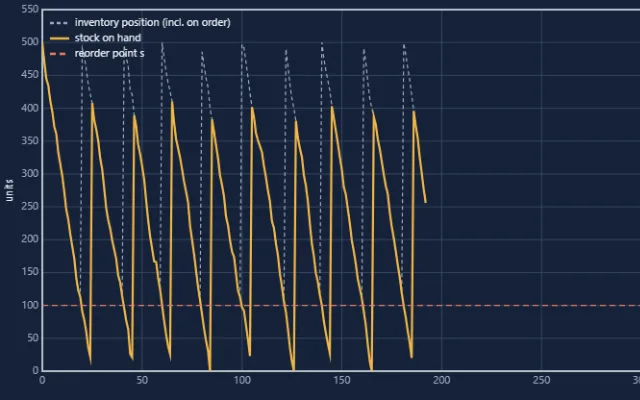
Run a shop's stock day by day with random demand, set the reorder point, order size and lead time, and compare stockouts and costs.
Operations & Economics · Inventory & Supply Chains
College & beyond College operations management
Launch simulator : Inventory Control
Supply Chain
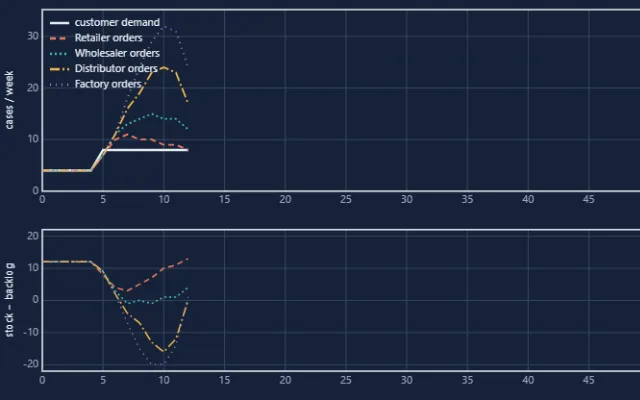
Run a four-stage supply chain, change demand and delays, and watch small changes in customer demand grow into the bullwhip effect.
Operations & Economics · Inventory & Supply Chains
College & beyond College operations management
Launch simulator : Supply Chain
Assembly Line
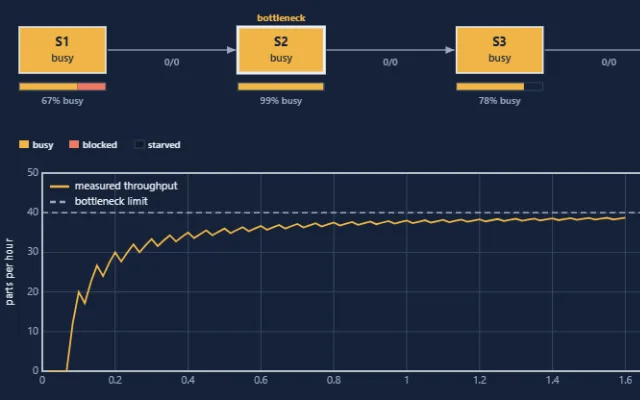
Simulate a serial production line, change station times, variability and buffer sizes, and find the bottleneck that sets throughput.
Operations & Economics · Queues & Flow
College & beyond College operations management
Launch simulator : Assembly Line
Traffic Signals
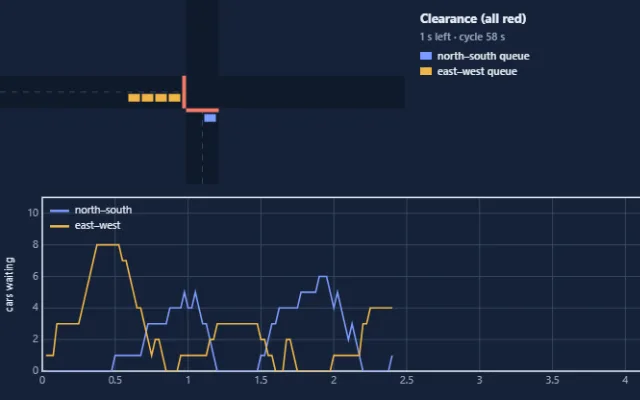
Time a two-phase traffic signal, change green times and arrival rates, and compare measured queues and delay with Webster's formula.
Operations & Economics · Queues & Flow
College & beyond College transport engineering
Launch simulator : Traffic Signals
Elevator Dispatch
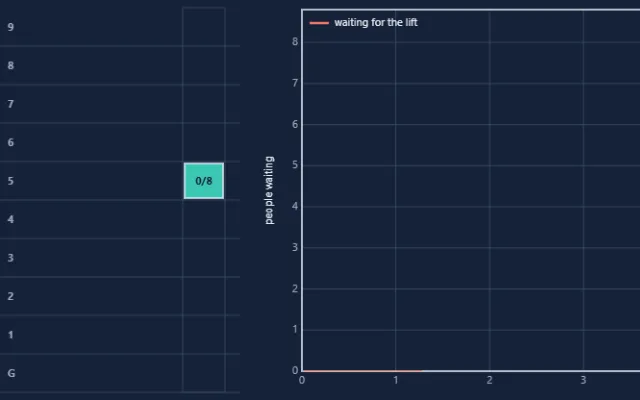
Run a lift in a ten-floor building, add calls, and compare first-come-first-served, nearest-stop and sweep scheduling on waiting time and fairness.
Operations & Economics · Scheduling & Routing
College & beyond College operations research
Launch simulator : Elevator Dispatch
Warehouse Picking
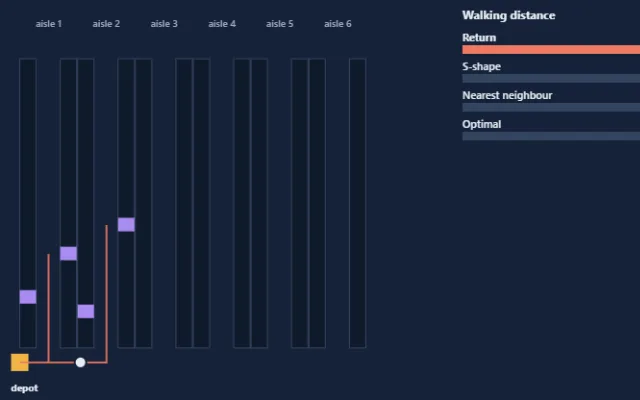
Place items to pick in a six-aisle warehouse and compare the walking distance of return, S-shape, nearest-neighbour and optimal picking routes.
Operations & Economics · Scheduling & Routing
College & beyond College operations research
Launch simulator : Warehouse Picking
Project Scheduling
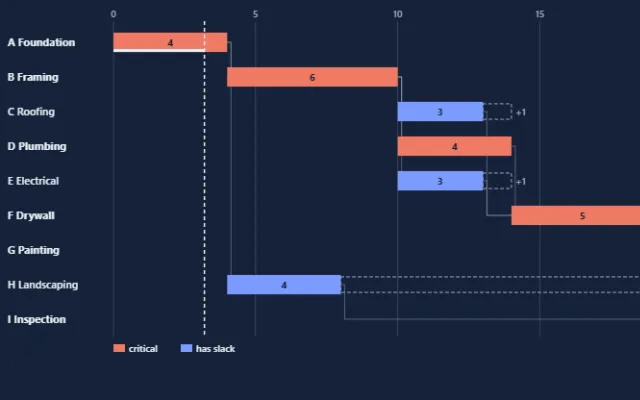
Edit task durations and dependencies in a building project and watch the critical path method find the project length and each task's slack.
Operations & Economics · Scheduling & Routing
College & beyond College project management
Launch simulator : Project Scheduling
Auction Mechanisms
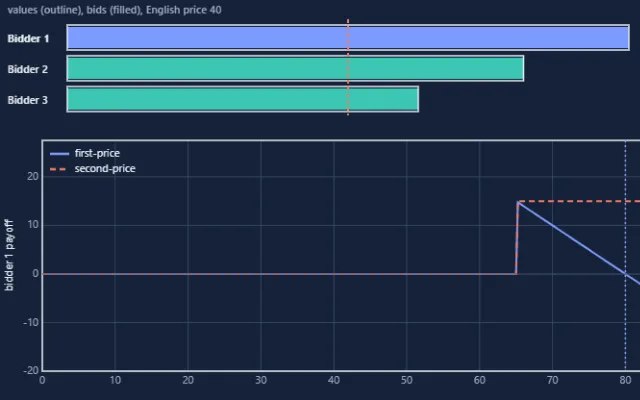
Compare who wins and what they pay in first-price, second-price, English and Dutch auctions, and test revenue equivalence over many random auctions.
Operations & Economics · Markets & Auctions
College & beyond College economics
Launch simulator : Auction Mechanisms
Market Supply and Demand
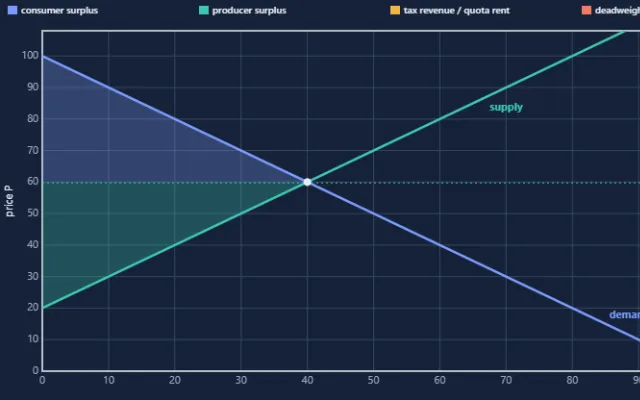
Shift supply and demand curves, add a tax, price ceiling, floor or quota, and see the equilibrium, consumer and producer surplus, and deadweight loss.
Operations & Economics · Markets & Auctions
Class 11–12 · College & beyond Class 12 Economics: Introductory Microeconomics (demand, supply, market equilibrium)
Launch simulator : Market Supply and Demand
Solar Panel Geometry
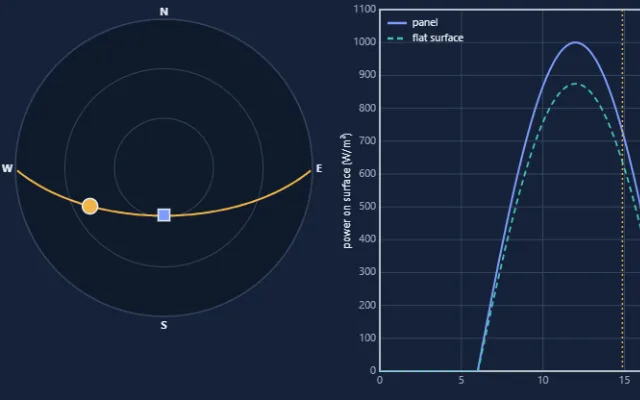
Change latitude, date, time, panel tilt and direction, and see the sun's path, the angle sunlight hits the panel, and daily energy.
Engineering · Energy Systems
Class 6–8 · Class 11–12 Class 6 Social Science: Earth's motions and seasons; Class 11 Geography: Solar Radiation, Heat Balance and Temperature
Launch simulator : Solar Panel Geometry
Wind Turbine
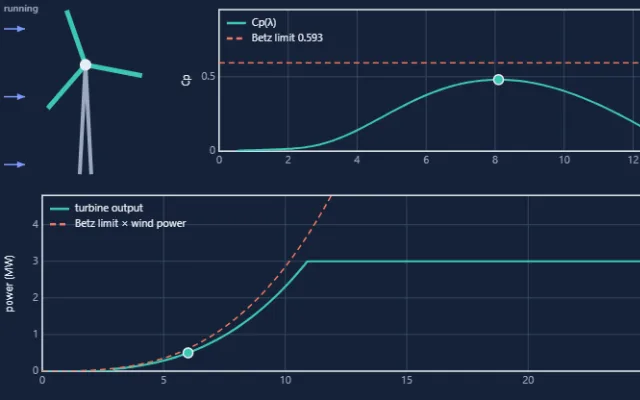
Change wind speed, rotor size, air density and control, and explore turbine power with the cube law, the Betz limit and tip-speed ratio.
Engineering · Energy Systems
Class 9–10 · College & beyond Builds on Class 9 Science: Work and Energy (kinetic energy)
Launch simulator : Wind Turbine
Battery Storage
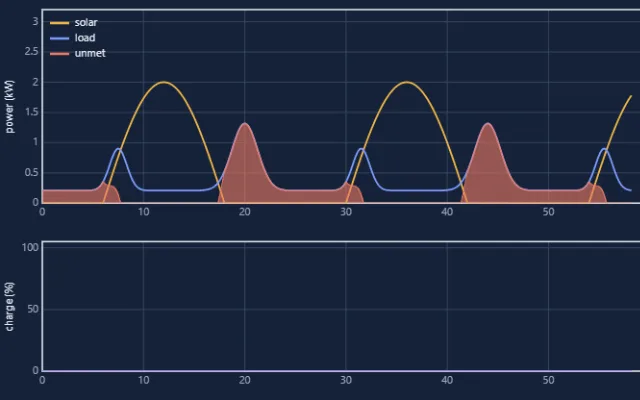
Size an off-grid solar battery system, set load and generation profiles, and track state of charge, unmet demand and spilled energy hour by hour.
Engineering · Energy Systems
Class 11–12 · College & beyond Builds on Class 12 Chemistry: Electrochemistry (batteries)
Launch simulator : Battery Storage
Grid Frequency
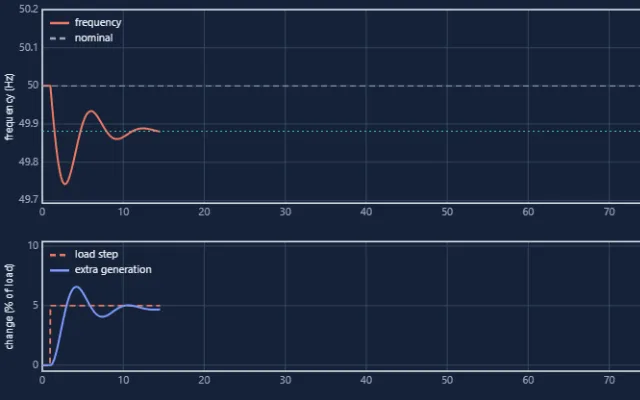
Trip a power station or add load, and watch the grid's frequency fall and recover through inertia, governor droop and automatic control.
Engineering · Energy Systems
College & beyond College power systems
Launch simulator : Grid Frequency
Building Insulation
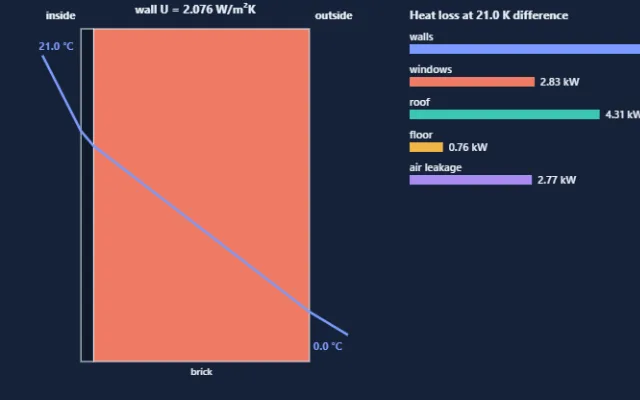
Choose insulation, glazing and air-tightness for a two-storey house and compare U-values, the temperature through the wall and heat loss.
Engineering · Energy Systems
Class 11–12 · College & beyond Class 11 Physics: Thermal Properties of Matter (conduction)
Launch simulator : Building Insulation
Rainwater Harvesting
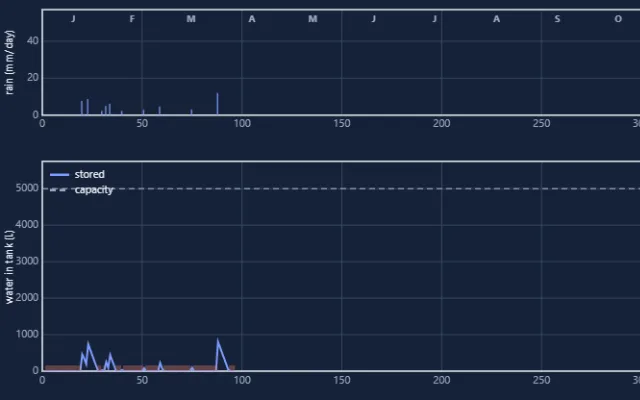
Set rainfall pattern, roof size, tank capacity and daily use, then run a year of daily water balance and track tank level, overflow and shortages.
Earth & Environment · Water & Hydrology
Class 6–8 · Class 9–10 Class 10 Geography: Water Resources (rainwater harvesting)
Launch simulator : Rainwater Harvesting
Watershed Runoff
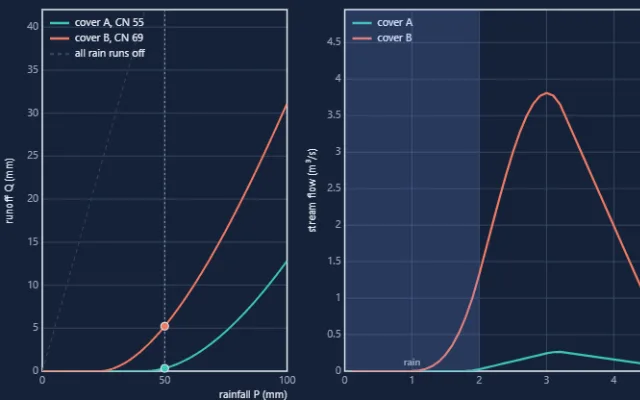
Change storm size and land cover for a small catchment, and compare simplified runoff curves and flood hydrographs with the SCS curve number method.
Earth & Environment · Water & Hydrology
Class 9–10 · College & beyond Class 10 Geography: Water Resources
Launch simulator : Watershed Runoff
Carbon Cycle
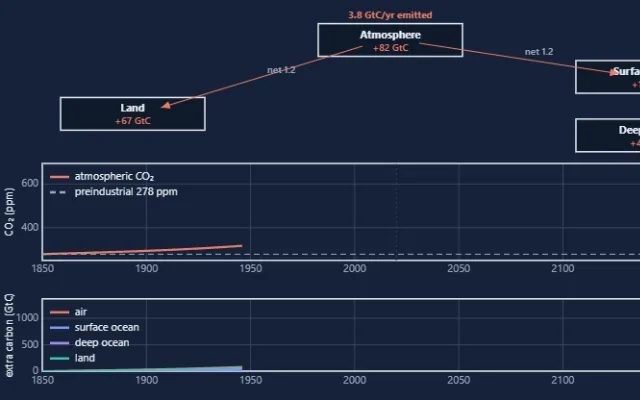
Run a four-reservoir carbon cycle model from 1850 to 2200, change future emissions, and track atmospheric CO₂ and where the carbon goes.
Earth & Environment · Climate & Carbon
Class 11–12 · College & beyond Class 11 Geography: World Climate and Climate Change
Launch simulator : Carbon Cycle
Urban Heat
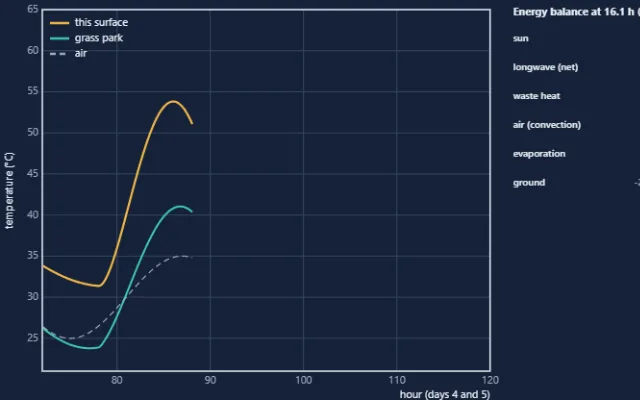
Change a city surface's colour, shade, vegetation and heat storage, and compare its energy balance and day–night temperatures with a park.
Earth & Environment · Climate & Carbon
Class 11–12 · College & beyond Class 11 Geography: Solar Radiation, Heat Balance and Temperature
Launch simulator : Urban Heat
Recycling Systems
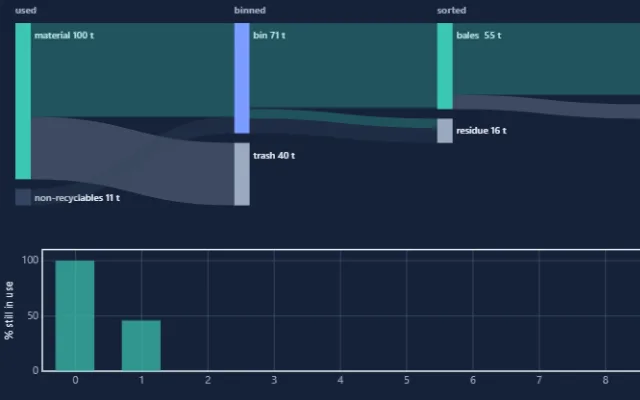
Follow 100 tonnes of packaging through collection, sorting and reprocessing, and see how much becomes new material over repeated cycles.
Earth & Environment · Resources & Waste
Class 6–8 · Class 9–10 Class 10 Science: Our Environment (managing waste)
Launch simulator : Recycling Systems
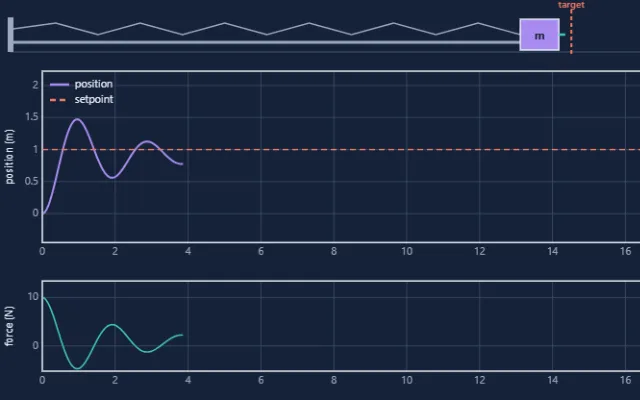
PID Control
Tune P, I and D gains on a mass–spring–damper, add disturbances and actuator limits, and see overshoot, settling time and steady-state error.
Engineering · Control Systems
College & beyond College control engineering
Launch simulator : PID Control
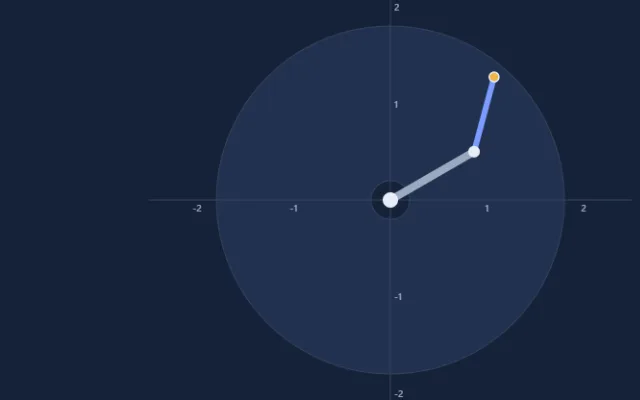
Robot Arm
Set joint angles or drag a target for a two-link robot arm, and explore forward and inverse kinematics, elbow-up and elbow-down, and reach.
Engineering · Control Systems
Class 11–12 · College & beyond Builds on Class 11 Maths: Trigonometric Functions
Launch simulator : Robot Arm
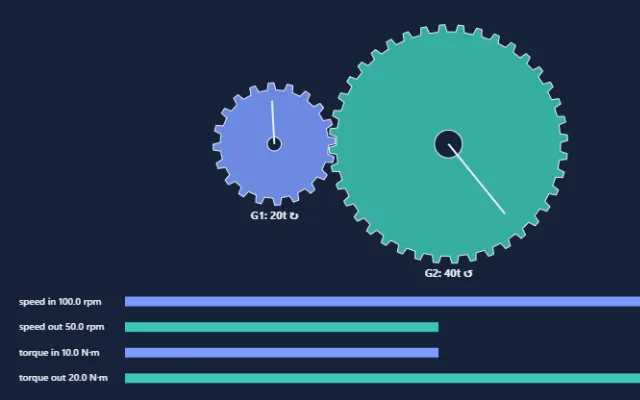
Gear Trains
Change tooth counts in simple and compound gear trains, and inspect rotation direction, speed ratio and ideal output torque with animated meshing gears.
Engineering · Structures & Mechanisms
Class 6–8 · College & beyond Builds on Class 6–8 Maths: ratio and proportion
Launch simulator : Gear Trains
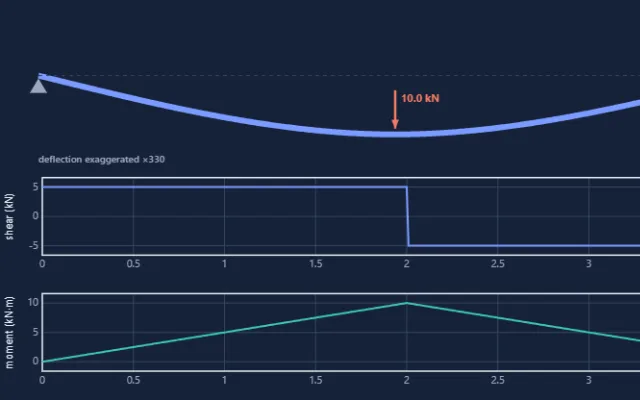
Beam Deflection
Load simply supported or cantilever beams, change span, material and section, and see deflection, bending moment, shear and stress.
Engineering · Structures & Mechanisms
College & beyond College structural engineering
Launch simulator : Beam Deflection
Truss Forces
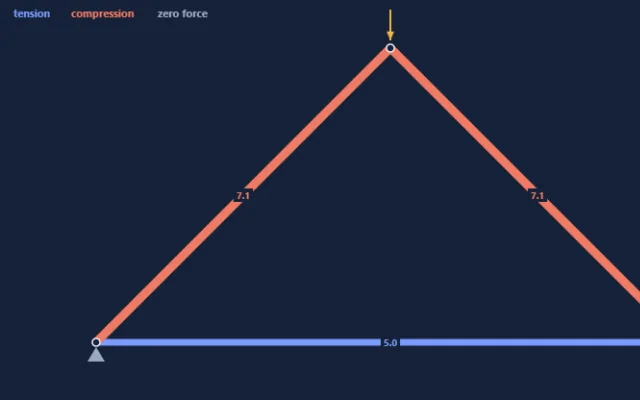
Load Pratt, Howe, Warren and A-frame trusses, change span, height and loads, and see tension and compression in every member by the method of joints.
Engineering · Structures & Mechanisms
Class 11–12 · College & beyond Builds on Class 11 Physics: Laws of Motion (equilibrium of forces)
Launch simulator : Truss Forces
Vibration Isolation
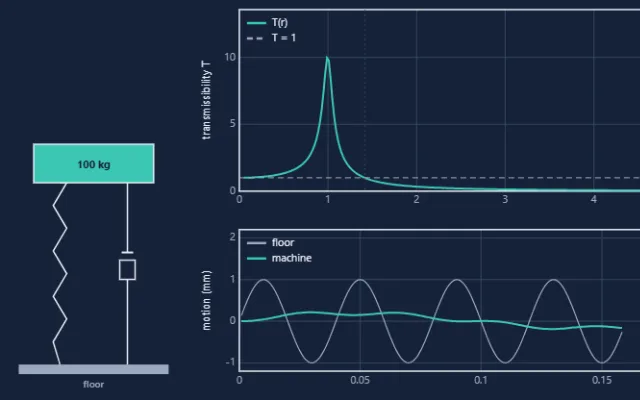
Mount a machine on springs and dampers over a shaking floor, change mass, stiffness, damping and frequency, and compare transmissibility.
Engineering · Structures & Mechanisms
Class 11–12 · College & beyond Class 11 Physics: Oscillations (forced oscillations, resonance)
Launch simulator : Vibration Isolation
Digital Sampling
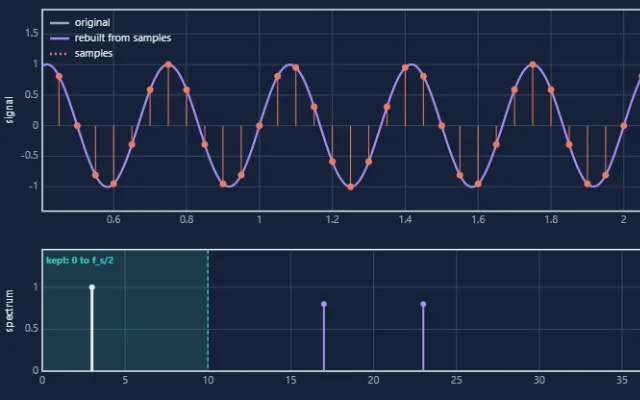
Change a signal's frequency and sampling rate, see aliasing, compare reconstructions, and see how quantization bits limit precision.
Engineering · Signals & Data
College & beyond College signals and systems
Launch simulator : Digital Sampling
Audio Filtering
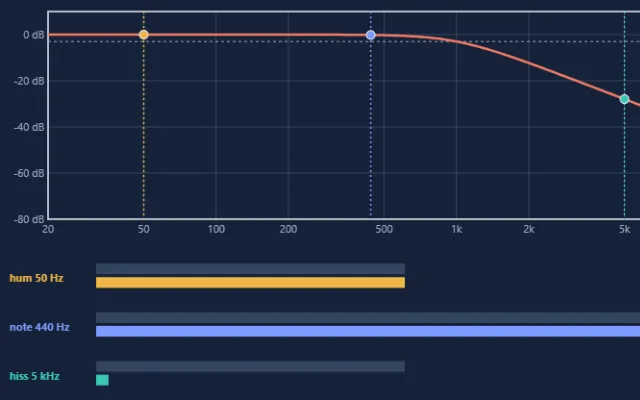
Apply low-pass, high-pass, band-pass and notch filters, see the frequency response in decibels, and hear what they do to hum, a tone and hiss.
Engineering · Signals & Data
College & beyond College signals and systems
Launch simulator : Audio Filtering
Image Convolution
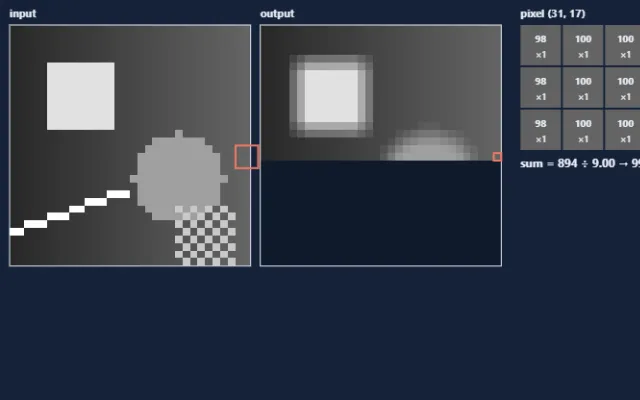
Edit a 3 × 3 kernel and step through convolution pixel by pixel to see how blur, sharpening and edge detection transform a small test image.
Engineering · Signals & Data
College & beyond College image processing
Launch simulator : Image Convolution
Compression Coding
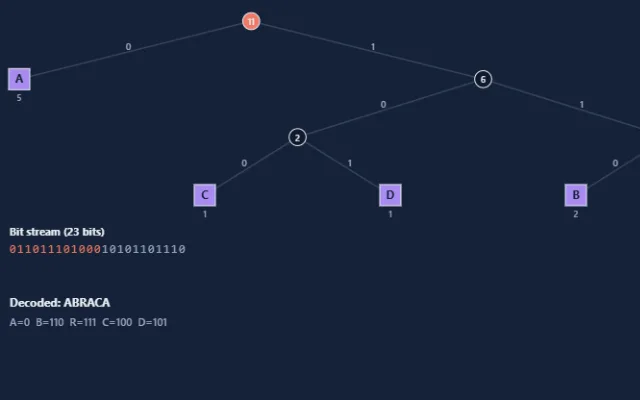
Edit sample text, build its Huffman code tree, compare bit counts with plain and fixed-length codes and the entropy limit, and watch the bits decode one by one.
Computer Science · Security & Coding
College & beyond College information theory
Launch simulator : Compression Coding
No simulators match Try a different word, or clear the filters.
Reset filters